
A rigid-flex quote can look complete without telling you much. The manufacturer states a layer count, lists a certification, references successful boards for other customers, and the numbers line up with the target price. None of that confirms that the certification covers the facility building your board, that the referenced boards used a comparable bend construction, or that the quoted lead time reflects your actual process route rather than a generic estimate.
“Reliable” in this context does not describe how the finished board performs under repeated flexing or thermal cycling — that outcome depends on design and material choices covered elsewhere. It describes whether the manufacturer’s claims about process, quality, and schedule hold up when checked against actual records, and whether that evidence stays consistent from the quote stage through pilot run and into production. A manufacturer can build a mechanically sound board and still be unreliable to work with, if the paperwork behind each claim keeps shifting or doesn’t match what the factory can actually show you.
The sections below cover what to ask for at each stage of evaluation and how to judge whether the answer is specific enough to trust. None of it produces a ranked list or a single score — a manufacturer that’s a strong match for a static, low-layer-count design may not be the right choice for a dynamic hinge application, and the evidence that matters shifts accordingly.
Table of contents
- Confirm the Manufacturer Can Build Your Stackup
- What Good Rigid-Flex DFM Feedback Should Include
- Verify the Quality System Behind the Certificate
- Material Control and Traceability
- What a Certificate Actually Covers
- Evidence from Prototype, Pilot Run, and Production
- Prototype and Pilot-Run Records
- Evidence of Process Stability and Defect Control
- Define the Required Tests and Acceptance Criteria
- Lead Time Commitments and Change Control
- What the Quoted Lead Time Includes
- How Material and Process Changes Are Approved
- The Final Check: Do the Claims and Evidence Stay Consistent?
Confirm the Manufacturer Can Build Your Stackup
A rigid-flex capability list on a manufacturer’s website is written to sound the same regardless of who’s asking: layer counts up to some maximum, coverlay and flexible-circuit experience, static and dynamic flex support. None of that confirms the shop can build the specific construction your design calls for.
The capability that actually matters is narrower: the layer count and material set in your stackup, the number of flex layers and where they route relative to rigid sections, whether the design needs vias or components inside the flex zone, how the transition between rigid and flex material is detailed, and whether the board requires sequential lamination, forming, or an unusual outline. A manufacturer that regularly builds two-layer static flex-to-rigid boards is not automatically qualified to build a six-layer dynamic hinge design with staggered layer transitions, even if both fall under the same “rigid-flex” capability claim.
Ask for evidence tied to a comparable build rather than a general capability statement: a stackup drawing or cross-section from a board with a similar layer count and bend type, confirmation of which stiffener and bonding materials they’ve actually processed — not just materials they say they support — and whether sequential lamination, if your design needs it, is a routine process step or something they’d be attempting for the first time. A manufacturer that can speak specifically to your transition-zone detail and material combination is showing you something a generic capability list cannot.
For a detailed overview of supported layer counts, material options, bend configurations, inspection, and engineering support, review Sugamed’s flex and rigid-flex PCB capabilities.
What Good Rigid-Flex DFM Feedback Should Include
DFM feedback on a rigid-flex quote is one of the fastest ways to judge whether a manufacturer understands your design, because generic feedback is easy to spot. A comment like “confirm bend radius meets minimum requirements” applies to every rigid-flex board ever quoted and says nothing about whether your specific radius is a problem. Feedback that references your actual transition detail, flex-area via placement, or a coverlay opening near a bend line is doing real engineering review, not running a template.
Useful DFM feedback also separates what has to change from what the manufacturer is recommending. A note that a via inside the active bend area won’t survive the flex construction is a different kind of statement than a suggestion to add a local stiffener under a connector for better yield. Treating both as equally mandatory — or equally optional — makes it harder to judge how much the design actually needs to move before it’s manufacturable.
If the design goes through more than one DFM round, check whether the feedback stays consistent. A manufacturer that flags a transition-zone issue in the first review and doesn’t mention it again after a minor revision, without explaining why the concern no longer applies, is a sign the review wasn’t tracking the design closely — something that becomes more important once the design moves toward production and further changes get proposed.
Verify the Quality System Behind the Certificate
A certification name on a manufacturer’s website establishes that some quality system exists somewhere in the organization. It does not establish that the system applies to the facility building your board, or that day-to-day records back up what the certificate implies. Two things are worth checking separately: whether the manufacturer actually controls and can trace the materials going into your board, and what the certificate itself covers.
Material Control and Traceability
Ask how material lots are tracked from receipt through the finished board — whether a specific panel or job can be traced back to the polyimide, coverlay, or bonding-material lot used, and how substitutions are approved when a specified material isn’t available. A manufacturer that can produce lot records and a documented substitution-approval process for a past job is showing you the traceability actually works, rather than existing only as a stated policy.
Storage conditions matter for rigid-flex materials more than for standard rigid laminate, since polyimide-based products and adhesives can carry shelf-life and humidity sensitivities that standard FR4 doesn’t. If material-control and traceability records aren’t available, or the manufacturer can’t describe how a substitution would be approved and communicated, that’s a gap worth weighing against the rest of the evaluation — not a reason to assume the material control is fine because the certificate says so.
What a Certificate Actually Covers
For medical PCB fabrication services, a certificate names a legal entity, lists a scope of activities, and applies to specific facility addresses — all three should match the factory that will actually build your board, not just the parent company or group the factory belongs to. A certificate held by a corporate headquarters doesn’t automatically extend to every manufacturing site under that umbrella, and a multi-site supplier may have only one facility within scope.
The scope statement matters more than the certificate name. ISO 9001 covers a general quality management system; it is not evidence of a medical-device-specific quality system, and it should not be treated as equivalent to ISO 13485 or as automatically satisfying IPC Class 3 or other elevated requirements. If your project has a specific certification requirement, check that the certificate’s stated scope, the covered facility, and the current validity date all match — a certificate that has expired, or that covers a different process scope than what you need, doesn’t satisfy the requirement just because it carries the same standard name.
Evidence from Prototype, Pilot Run, and Production
Capability claims and quality documentation describe what a manufacturer says it can do. Prototype and pilot-run records show what actually happened the last time they built something similar — and for rigid-flex boards specifically, this stage is where transition-zone problems, coverlay registration issues, or material-handling gaps tend to surface first.
Prototype and Pilot-Run Records
Ask what changed between the first prototype revision and the version approved for pilot or production: which issues came up, what corrected them, and whether the fix was a design change, a process adjustment, or a material substitution. A manufacturer that can walk through that history for a recent job is demonstrating the kind of process visibility you’ll need once your own design moves through the same stages.
Pilot-run records specifically should show whether the move from prototype quantities to a small production batch introduced new issues — panel yield at pilot volume, handling damage in the flex area, or fixture and tooling problems that didn’t appear in a handful of prototype units. A design that built cleanly as five prototype boards can still expose problems at fifty, and pilot-run data is the evidence that bridges that gap.
Evidence of Process Stability and Defect Control
Yield and defect data are also among the hardest claims in a rigid-flex quote to verify independently. Without access to a manufacturer’s actual production records, there’s no reliable way to confirm a stated yield percentage, and a manufacturer shouldn’t be expected to disclose precise yield figures tied to other customers’ jobs.
What can reasonably be requested is evidence of how defects are classified and handled: whether defect categories are tracked at all, how a recurring defect gets root-caused and closed out, and whether microsection or cross-section results are used to confirm a process fix rather than just to document a failure after the fact. A manufacturer that can describe a specific defect they identified and corrected — rather than asserting a generic high-yield claim — is giving you something you can actually evaluate. Consistency matters here too: if a manufacturer’s account of their defect-control process is vague at the quote stage and stays vague through pilot run, that’s a pattern rather than a one-time answer that will improve once you’re a bigger account.
Define the Required Tests and Acceptance Criteria
Electrical test coverage and physical inspection criteria need to be agreed before production starts, not inferred from what the manufacturer normally does. Confirm which tests apply — continuity and isolation against the netlist, and any physical checks specific to the rigid-flex construction such as coverlay registration or transition-edge inspection — and whether they run on every board or on a sampling basis.
Acceptance criteria should be explicit enough that a failed unit and a passing unit aren’t a matter of interpretation: what measurement or visual standard defines a pass, what happens to units that fail, and how test records are kept and made available if a field issue traces back to a production lot. Deeper reliability validation — bend-cycle testing, thermal cycling, and similar qualification work — sits outside standard acceptance testing and is worth treating as its own evaluation once the manufacturing relationship is established, rather than folding it into every production lot’s acceptance criteria.
Lead Time Commitments and Change Control
Lead time and change control are less about the manufacturer’s technical capability and more about whether their commitments hold up once your order is one of many in their schedule.
What the Quoted Lead Time Includes
A quoted lead time is only useful if you know what it covers. Ask whether the number includes material procurement — which can be a longer lead item for specialty polyimide or bonding materials than for standard FR4 — engineering and DFM review time, the manufacturing cycle itself, testing, any customer approval step, and shipping. A lead time that excludes material procurement or approval turnaround can look shorter than the time you’ll actually wait, without either party stating anything inaccurate.
How Material and Process Changes Are Approved
Ask how the manufacturer handles a material substitution, a stackup adjustment, or any other process change after your design is approved: whether it requires written notification and your sign-off before it happens, or whether it’s treated as within their normal process latitude and only reported after the fact. This carries more weight for rigid-flex builds than for standard rigid PCBs, because a substituted bonding material or a different coverlay adhesive can change bend performance in ways that aren’t obvious from a change notice alone.
A manufacturer with a documented change-control process — one that specifies what triggers a customer notification and what doesn’t — gives you a way to catch a change before it affects your board. One without that process may still communicate changes reliably, but you’re relying on their judgment about what’s worth telling you rather than an agreed standard.
The Final Check: Do the Claims and Evidence Stay Consistent?
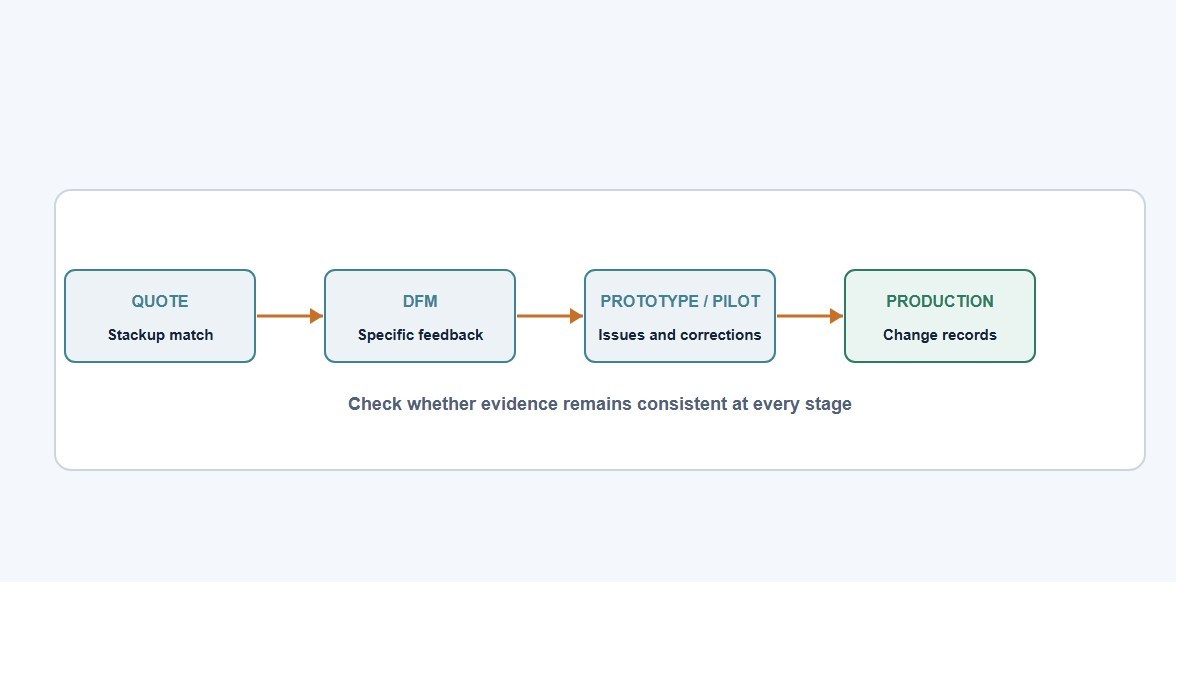
Each of the sections above evaluates a different piece of the manufacturer’s claims — capability, engineering review, quality system, production history, testing, and commercial terms. The more useful check happens across them: does the evidence a manufacturer provides at the quote stage still match what shows up in pilot-run records, DFM follow-up, and change notifications once the project is underway? A manufacturer whose capability claims, DFM comments, and material documentation all point to the same level of process control is a more dependable partner than one that scores well on any single category but can’t produce consistent evidence across stages.
When time doesn’t allow a full evaluation against every point above, three checks carry the most weight:
- Whether the manufacturer’s stackup and process capability match your specific construction — not a generic rigid-flex capability claim — confirmed through DFM feedback that engages with your actual design.
- Whether quality and traceability evidence is tied to the facility that will actually build your board, not to a certificate held elsewhere in the organization.
- Whether prototype and pilot-run records show a manufacturer that identifies and corrects problems consistently, rather than one that only claims a clean process history.
A manufacturer that holds up on these three is more likely to hold up on the rest. One that’s vague on any of them is worth more scrutiny before the project moves further, regardless of how complete the quote and certificate package look on paper.