
Medical Flex PCB and Rigid-Flex PCB Manufacturing
Home » Flex & Rigid-Flex
We provide Flex PCB and Rigid-Flex PCB manufacturing services for medical electronics projects that require space-efficient board designs, bendable interconnects, three-dimensional packaging, or fewer board-to-board connectors and wire harnesses.
Our support covers stack-up and bend-zone review, PCB fabrication, inspection, electrical testing, and subsequent PCB assembly.
- Flex PCB: 1–6 layers
- Rigid-Flex PCB: 2–14 layers
- Minimum trace width/spacing down to 3/3 mil; selected Flex designs can be reviewed down to 2/2 mil
- Polyimide, adhesiveless PI, and FR-4 / High-Tg materials for rigid sections
- FR-4, Polyimide, and stainless-steel stiffeners
- Controlled impedance and electrical testing
When Should You Use Flex or Rigid-Flex PCB?
Flex and Rigid-Flex PCBs are primarily used to address space, bending, and board-to-board interconnection challenges that are difficult to solve with conventional rigid PCBs. Whether this construction is appropriate depends on the device’s internal layout, connection method, and the mechanical requirements of the flexible section during actual use.
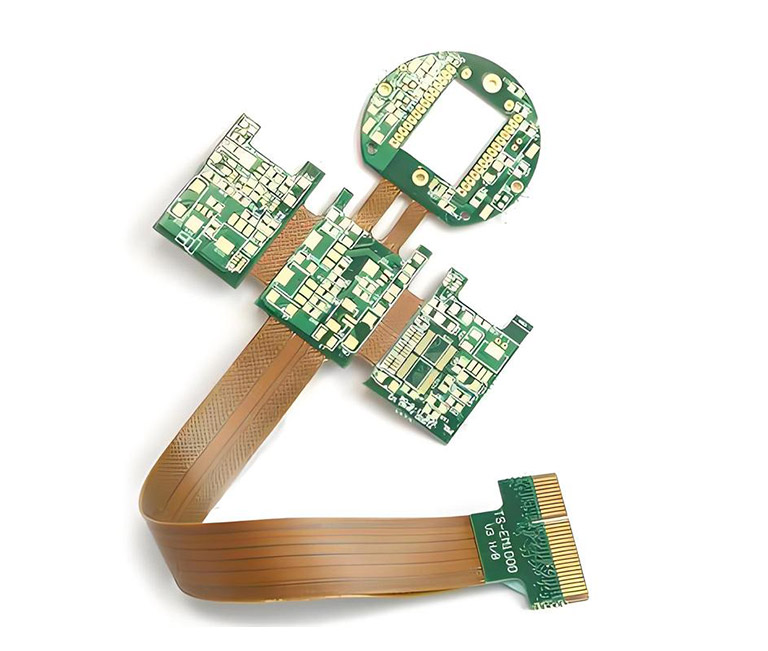
When the PCB Must Fit Limited or Irregular Internal Spaces
When a device cannot accommodate a flat rigid PCB, a Flex PCB can be routed along the inside of the enclosure, around mechanical structures, or through changes in direction.
A Rigid-Flex PCB can integrate multiple rigid functional areas with flexible interconnect sections on a single board, allowing different component-mounting areas to follow the device’s three-dimensional mechanical layout.
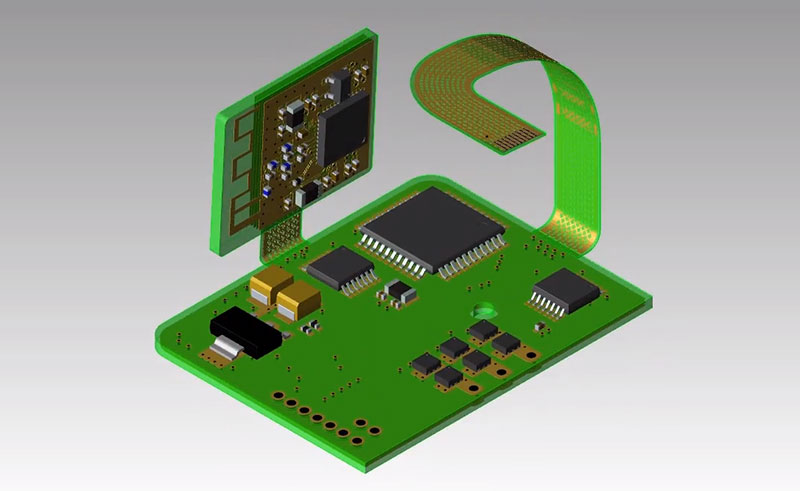
When the Design Needs Fewer Board-to-Board Connectors or Wire Harnesses
Multiple rigid PCBs typically require FFCs, wire harnesses, or board-to-board connectors for interconnection.
Where the mechanical design allows, a Rigid-Flex PCB can integrate some of these interconnections directly into the PCB. This can reduce separate cables and connectors while simplifying the internal assembly.
However, the decision to use Rigid-Flex should also consider available space, assembly method, serviceability, and manufacturing cost. Fewer connectors are not always the best solution.
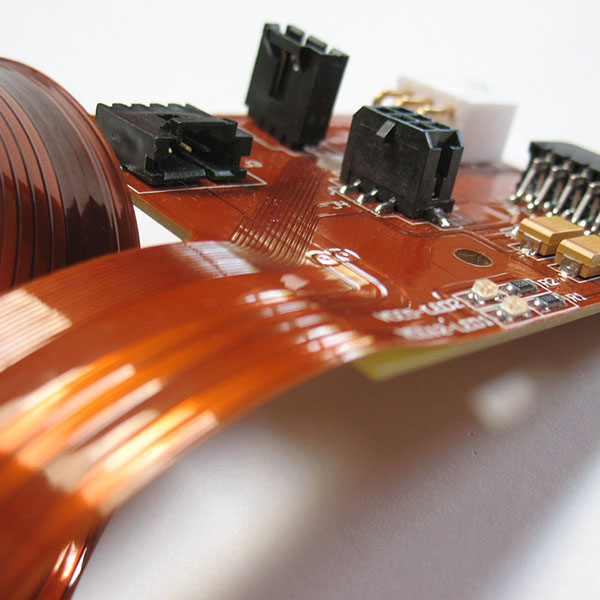
When the Flexible Section Must Bend During Assembly or Use
The bending requirements for a Flex PCB can vary significantly depending on how the product is used.
Some flexible sections are bent once during assembly and then remain in a fixed position. Others must move repeatedly while the product is operating. These two applications have different requirements for copper type, Flex thickness, bend radius, trace direction, Coverlay, and layer count.
For Dynamic Flex applications, the actual motion profile and target cycle count should be defined before the stack-up is finalized.
What Is the Difference Between Flex PCB and Rigid-Flex PCB?
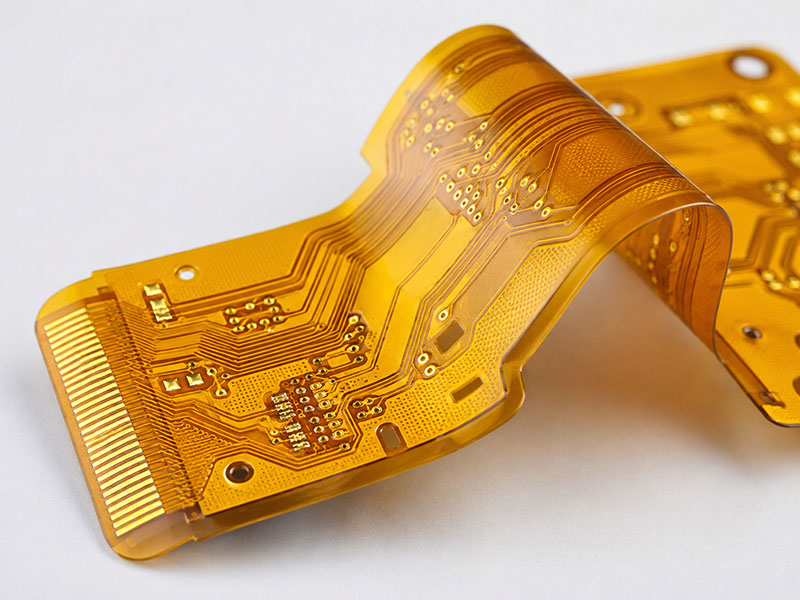
Both Flex PCB and Rigid-Flex PCB designs can use Polyimide flexible materials, but their overall construction and applications are different.
If the design only requires a flexible connection section, a Flex PCB may be sufficient.
If multiple rigid component-mounting areas must be connected through flexible sections as one integrated assembly, a Rigid-Flex construction may be more appropriate for further evaluation.
| Comparison | Flex PCB | Rigid-Flex PCB |
|---|---|---|
| Basic construction | Primarily a flexible circuit structure | Rigid and flexible sections integrated into one PCB |
| Main applications | Flexible interconnects, thin connections, static or dynamic bending | Three-dimensional packaging, interconnection between multiple rigid sections, reduced cabling or board-to-board connectors |
| Typical layer count | 1–6 layers | 2–14 layers |
| Component assembly | Components can be mounted in areas supported by a stiffener or other reinforcement | Components are typically mounted on rigid sections, while Flex Zones primarily provide interconnection |
| Mechanical support | FR-4, PI, or metal stiffeners can be added where required | Rigid sections provide component support and mechanical stability |
| Manufacturing complexity | Relatively low for simple constructions | Typically higher because both rigid and flexible material systems must be controlled |
| Best suited for | Thin, lightweight, or flexible interconnects | Integrating multiple structural or component-mounting areas into one PCB |
Basic construction
Flex PCB
Primarily a flexible circuit structure
Rigid-Flex PCB
Rigid and flexible sections integrated into one PCB
Main applications
Flex PCB
Flexible interconnects, thin connections, static or dynamic bending
Rigid-Flex PCB
Three-dimensional packaging, interconnection between multiple rigid sections, reduced cabling or board-to-board connectors
Typical layer count
Flex PCB
1–6 layers
Rigid-Flex PCB
2–14 layers
Component assembly
Flex PCB
Components can be mounted in areas supported by a stiffener or other reinforcement
Rigid-Flex PCB
Components are typically mounted on rigid sections, while Flex Zones primarily provide interconnection
Mechanical support
Flex PCB
FR-4, PI, or metal stiffeners can be added where required
Rigid-Flex PCB
Rigid sections provide component support and mechanical stability
Manufacturing complexity
Flex PCB
Relatively low for simple constructions
Rigid-Flex PCB
Typically higher because both rigid and flexible material systems must be controlled
Best suited for
Flex PCB
Thin, lightweight, or flexible interconnects
Rigid-Flex PCB
Integrating multiple structural or component-mounting areas into one PCB
Flex and Rigid-Flex PCB Manufacturing Capabilities
The following specifications are intended to support preliminary project evaluation. Final manufacturability must be confirmed based on the complete stack-up, including layer count, copper thickness, trace width/spacing, Flex Zone thickness, and bending requirements.
Flexible PCB Manufacturing Capabilities
| Parameter | Capability |
|---|---|
| Layer count | 1–6 layers |
| Base material | Polyimide (PI), including standard and adhesiveless constructions |
| Minimum trace width / spacing | 3/3 mil standard; 2/2 mil designs subject to review |
| Laser via diameter | 0.15 mm; final capability depends on the design structure |
| Copper thickness | 0.5–2 oz |
| Flex Zone thickness | 0.05–0.4 mm |
| Bend radius | Evaluated based on Flex thickness, layer count, copper structure, and static or dynamic use |
| Surface finish | ENIG / Immersion Silver / OSP |
| Stiffener | FR-4 / Polyimide / Stainless Steel, according to design requirements |
| Coverlay | Polyimide Coverlay; Solder Mask may be used for selected designs |
Layer count
Capability
1–6 layers
Base material
Capability
Polyimide (PI), including standard and adhesiveless constructions
Minimum trace width / spacing
Capability
3/3 mil standard; 2/2 mil designs subject to review
Laser via diameter
Capability
0.15 mm; final capability depends on the design structure
Copper thickness
Capability
0.5–2 oz
Flex Zone thickness
Capability
0.05–0.4 mm
Bend radius
Capability
Evaluated based on Flex thickness, layer count, copper structure, and static or dynamic use
Surface finish
Capability
ENIG / Immersion Silver / OSP
Stiffener
Capability
FR-4 / Polyimide / Stainless Steel, according to design requirements
Coverlay
Capability
Polyimide Coverlay; Solder Mask may be used for selected designs
Rigid-Flex PCB Manufacturing Capabilities
If the rigid sections also include higher-density routing, blind or buried vias, microvias, or via-in-pad structures, the design can be evaluated together with our HDI PCB manufacturing capabilities.
| Parameter | Capability |
|---|---|
| Layer count | 2–14 layers; total rigid and flexible layers evaluated according to the stack-up |
| Rigid Zone material | FR-4; High-Tg materials available for selected projects |
| Flex Zone material | Polyimide (PI) |
| Minimum trace width / spacing | 3/3 mil |
| Impedance control | ±10% standard; tighter requirements subject to project review |
| Flex Zone thickness | 0.05–0.2 mm |
| Rigid Zone thickness | 0.4–2.4 mm |
| Surface finish | ENIG / Immersion Silver |
| Electrical testing | 100% electrical testing; Flying Probe or fixture testing selected according to the order |
| AOI | Inner- and outer-layer AOI according to the manufacturing process |
Layer count
Capability
2–14 layers; total rigid and flexible layers evaluated according to the stack-up
Rigid Zone material
Capability
FR-4; High-Tg materials available for selected projects
Flex Zone material
Capability
Polyimide (PI)
Minimum trace width / spacing
Capability
3/3 mil
Impedance control
Capability
±10% standard; tighter requirements subject to project review
Flex Zone thickness
Capability
0.05–0.2 mm
Rigid Zone thickness
Capability
0.4–2.4 mm
Surface finish
Capability
ENIG / Immersion Silver
Electrical testing
Capability
100% electrical testing; Flying Probe or fixture testing selected according to the order
AOI
Capability
Inner- and outer-layer AOI according to the manufacturing process
Flex and Rigid-Flex PCB Structures We Manufacture
Flex and Rigid-Flex PCBs are not limited to one standard construction. The final stack-up must be selected according to the bending method, component locations, routing density, and mechanical relationship between the rigid and flexible sections.
Single-Layer Flex
A single-conductor-layer structure with a Polyimide base material and Coverlay is suitable for relatively simple designs that prioritize thinness and flexible interconnection.
Double-Layer Flex
Two copper layers are connected through the required via structures. This provides more routing capacity than a single-layer Flex PCB while maintaining a flexible construction.
Multilayer Flex
Multilayer Flex structures can be used when routing density increases.
As the layer count increases, the overall Flex Zone thickness and bending strain also increase. Routing density should therefore be evaluated together with bend radius and the actual mechanical use conditions.
Rigid-Flex PCB
Rigid-Flex PCBs integrate rigid sections, such as FR-4 areas, with Polyimide flexible sections in a single PCB construction.
The rigid sections typically support components and higher-density routing. Devices such as BGAs, ICs, and connectors are generally placed in these areas. The flexible sections connect the rigid areas and accommodate folding, changes in direction, or routing through mechanical structures.
If the flexible section must undergo continuous dynamic bending, this requirement should be identified during the early design stage rather than treating the board as a standard installation-type Rigid-Flex PCB.
DFM Review for Flex and Rigid-Flex PCBs
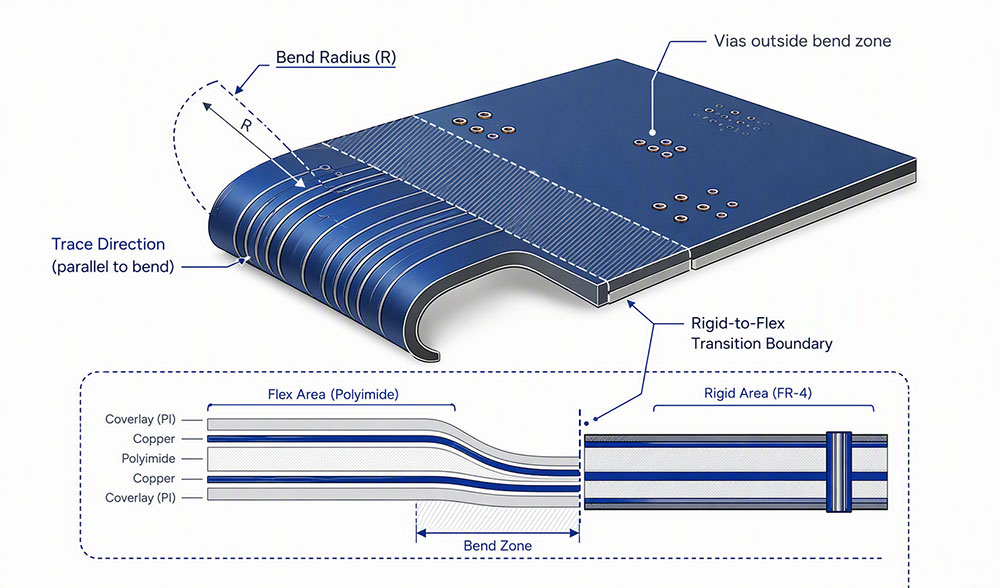
The manufacturability of a Flex PCB depends on more than the trace dimensions shown in the Gerber files. Bend zones, copper construction, Coverlay openings, stiffeners, and rigid-to-flex transitions must also be reviewed before production.
Flex Zone and Bend Radius
Bend radius should not be determined by applying one fixed multiplier to every design.
The review should consider the total Flex thickness, layer count, copper thickness, and copper type. It should also confirm whether the section will be bent during assembly or subjected to continuous dynamic bending. For Dynamic Flex applications, the target cycle count and actual motion profile must also be considered.
These factors are interdependent. For example, a multilayer Flex PCB and a thinner single-layer Flex PCB will experience different levels of strain at the same bend radius.
Traces Through Bend Zones
Traces in bend zones should be routed in a direction that supports bending and minimizes unnecessary stress concentration.
The DFM review focuses on trace direction, trace-width transitions, and copper distribution. It also checks the position of pads and vias in the bend zone, as well as their relationship to the rigid-to-flex transition.
For designs that bend repeatedly, these factors are often more meaningful than discussing a minimum bend radius alone.
Vias and Rigid-to-Flex Transitions
Standard vias should not be placed arbitrarily in the primary bending area.
Rigid-Flex designs also require review of the distance between vias and the Flex Transition, the boundary structure between rigid and flexible sections, and the overlap between the Coverlay and rigid materials.
These details directly affect local mechanical stress and should therefore be confirmed together with the complete stack-up before production.
Coverlay Openings
Coverlay openings must meet the requirements of component pads, connection areas, and manufacturing tolerances.
An opening that is too small may affect pad exposure, while an opening that is too large may reduce the protection provided to the traces near the edge. Fine-pitch pads, connector contacts, and unusually shaped openings require particular attention to actual manufacturing tolerances.
Stiffeners
Not every area of a Flex PCB requires a stiffener.
Stiffeners are commonly used for connectors, ZIF contacts, component-mounting areas, and locations that require a defined installation thickness or additional mechanical support.
The material and thickness should be selected according to the final assembly structure rather than treated as a standard requirement for every Flex PCB.
Selecting Polyimide, Copper, and Flexible Materials
The performance of a flexible PCB is not determined by Polyimide alone.
The final construction combines Polyimide, copper, adhesive, Coverlay, stiffeners, and surface finish. The interaction between these materials affects PCB thickness, bending performance, processing conditions, and assembly behavior.
Polyimide Flex Material
Polyimide is a commonly used flexible insulating material for Flex PCBs. It provides good flexibility and can support the thermal processing requirements associated with PCB fabrication and lead-free assembly.
The processing temperature and long-term operating temperature of a specific material should be confirmed using the applicable laminate datasheet and the final application conditions rather than summarized by a single maximum temperature.
Adhesive and Adhesiveless Flex
Flex copper-clad laminates can use either adhesive or adhesiveless constructions.
An adhesiveless construction reduces the adhesive layer between the copper and Polyimide. It may be considered when the design requires a thinner Flex structure, improved bending performance, higher thermal performance, or finer circuitry.
The need for an adhesiveless construction is not determined by the fact that the product is used in a medical application. It should be selected according to the PCB structure and manufacturing requirements.
RA Copper and ED Copper
For Flex sections that must withstand repeated dynamic bending, Rolled Annealed (RA) copper is often preferred because its grain structure is better suited to repeated mechanical strain.
If the Flex section is bent primarily during assembly and then remains in a fixed position, the copper type can be selected based on the routing structure, cost, and manufacturing requirements.
Moisture Management
Polyimide can absorb moisture. During the manufacturing and assembly of Flex and Rigid-Flex PCBs, storage conditions and moisture exposure should therefore be managed according to the material characteristics. Baking may be required when appropriate.
This type of control is intended to support subsequent processing and assembly handling. It should not be reduced to a simple statement that the material is either moisture-resistant or moisture-sensitive.
Surface Finish
The surface finish for Flex and Rigid-Flex PCBs should be selected according to the actual assembly and connection method.
ENIG, Immersion Silver, and OSP each have suitable application conditions. If the project involves fine-pitch assembly, connector contacts, wire bonding, or other special reliability requirements, the appropriate surface finish should be selected based on the actual process rather than automatically choosing one finish because the product is used in medical electronics.
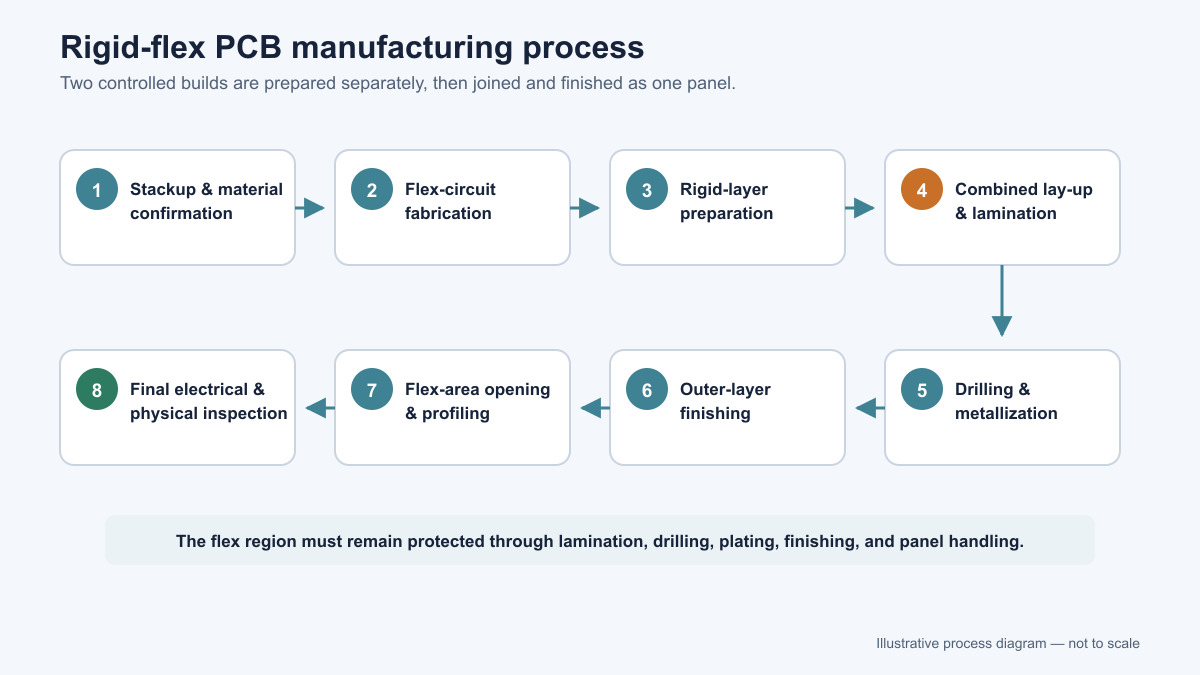
Manufacturing and Inspection Controls for Medical Flex and Rigid-Flex PCBs
For medical electronics projects, control of production file revisions, material batches, and inspection records is as important as the PCB construction itself.
Manufacturing Documentation and Revision Control
Production is carried out using approved manufacturing data, such as:
- Gerber / ODB++
- Drill Data
- Stack-Up
- Fabrication Drawing
- Mechanical Drawing
- Bend / Flex Zone Requirements
- Revision Information
When the design revision changes, the manufacturing data should be updated through the project document-control process rather than modified informally during production.
Material and Lot Records
According to project requirements, records can be maintained for Flex laminates, Coverlay, rigid materials, and related production lots.
If a material substitution could affect Flex thickness, bending performance, electrical properties, or thermal requirements, it should be reviewed and approved before implementation rather than replaced automatically.
In-Process Inspection
Depending on the PCB construction and manufacturing process, inspection may include:
- Inner-Layer AOI
- Outer-Layer AOI
- Dimensional Inspection
- Rigid-to-Flex Transition Inspection
- 100% Electrical Test
- Controlled-Impedance Verification where specified
- Cross-Section Inspection where required
For more complex Rigid-Flex PCBs, additional inspections can be added according to the project drawings and quality requirements.
IPC Acceptance Requirements
A medical electronics PCB is not automatically equivalent to IPC Class 3.
The applicable IPC class should be determined according to the product’s intended use, reliability requirements, risk assessment, customer specifications, and approved project documentation.
Some medical electronics projects may use IPC Class 2, while projects with higher reliability requirements may specify IPC Class 3 or another customer-defined acceptance standard.
ISO 13485 Quality System
Suga Electronics (Dongguan)’s ISO 13485:2016 certification scope covers PCB design support, manufacturing, and assembly for medical devices.
ISO 13485 governs the quality system and related manufacturing processes. It does not mean that an individual PCB is itself “medically certified,” nor does it automatically determine which IPC class a project must use.
Do You Need Other PCB Technologies?
Flex and Rigid-Flex PCBs primarily address structural and interconnection requirements. The same project may also require higher routing density, improved thermal performance, or other material options.
HDI PCB
If the rigid sections of a Rigid-Flex PCB include fine-pitch BGAs, microvias, blind or buried vias, via-in-pad structures, or higher routing density, an HDI and Rigid-Flex combination can be evaluated.
High-Tg PCB
If the rigid sections require a higher-Tg FR-4 material, the material can be selected according to the operating environment, assembly thermal cycles, and reliability requirements.
High-Tg materials are compatible with Rigid-Flex constructions when the materials are properly matched throughout the stack-up.
Rigid PCB
If the PCB can be mounted on a flat, fixed structure and does not require flexible interconnection or three-dimensional folding, a standard rigid multilayer PCB may provide a simpler construction and more predictable manufacturing cost.
Frequently Asked Questions About Flex and Rigid-Flex PCBs
What is the main difference between a Flex PCB and a Rigid-Flex PCB?
A Flex PCB is primarily a flexible circuit structure used for flexible interconnections, thin connections, and areas that need to bend.
A Rigid-Flex PCB integrates rigid PCB sections and flexible PCB sections into one board construction. Components are typically mounted on the rigid sections, while the flexible sections connect the rigid areas and accommodate changes in position or direction.
If the design only requires one flexible interconnect, a Flex PCB may be sufficient. If multiple rigid component-mounting areas must be connected through flexible sections, a Rigid-Flex PCB may be appropriate.
How many bending cycles can a Flex PCB withstand?
There is no single cycle rating that applies to every Flex PCB.
Bend life depends on factors including:
- Flex Thickness
- Bend Radius
- Flex Layer Count
- Copper Type
- Copper Thickness
- Trace Direction
- Bend Angle
- Mechanical Motion
If the product requires continuous bending during use, the target cycle count and actual motion conditions should be provided during the design stage. These requirements can then be used for DFM review and any necessary validation.
Can a stiffener be added to a Flex PCB?
Yes.
Depending on the mechanical requirements, FR-4, Polyimide, or stainless-steel stiffeners can be added to selected areas. Common locations include connectors, ZIF contacts, component-mounting areas, and areas that require additional mechanical support or a defined installation thickness.
A stiffener is not required for every Flex section and should be selected according to the final assembly structure.
Can Rigid-Flex PCBs be used for lead-free assembly?
Yes, but the assembly profile should be confirmed based on the specific Polyimide, rigid laminate, Coverlay, and complete material system.
The surface finish should also be selected according to the actual soldering and connection requirements rather than automatically choosing one finish because the project is used in medical electronics.
Does SugaMed provide Flex and Rigid-Flex PCB assembly?
Yes.
SugaMed provides PCB fabrication and subsequent PCB assembly services. For Rigid-Flex PCBs, components are typically mounted primarily on the rigid sections. Flex PCB assembly may require a carrier, stiffener, or other dedicated support method.
The actual assembly process is confirmed according to the PCB construction and project requirements.
Must a medical Flex PCB meet IPC Class 3?
Not necessarily.
The required IPC class depends on the product’s intended use, reliability requirements, risk assessment, and customer project specifications.
Some medical electronics projects use IPC Class 2, while projects with higher reliability requirements may require IPC Class 3. The final acceptance class should be defined in the approved project documentation.
Start Your Flex or Rigid-Flex PCB Project
For Flex and Rigid-Flex PCBs, mechanical and bending information can have a direct impact on manufacturability in addition to the Gerber files.
Where available, please provide:
- Gerber / ODB++
- Drill Files
- Stack-Up
- Fabrication Drawing
- Mechanical Drawing
- Flex Zone Dimensions
- Bend Radius
- Static / Dynamic Flex Requirement
- Target Bend Cycles where applicable
- Material Requirements
- Controlled-Impedance Requirements
- Quantity
- IPC / Customer Acceptance Requirements
If the final stack-up has not yet been completed, you can still submit the available design information. Our engineering team can evaluate the Flex construction, Rigid-Flex Transition, material selection, and key DFM conditions.