
HDI PCB for Medical Devices
Home » HDI PCB
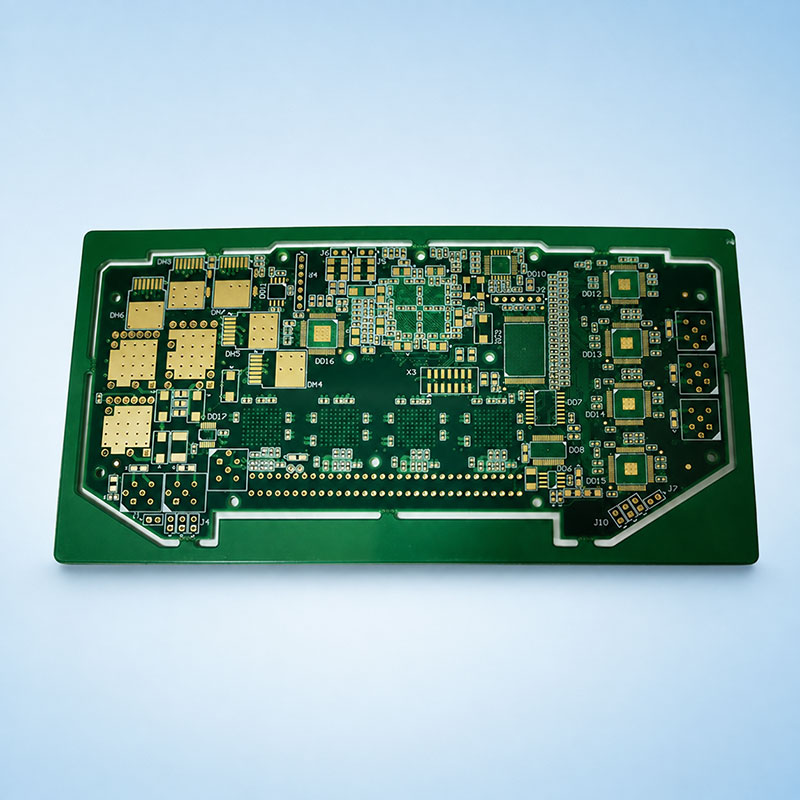
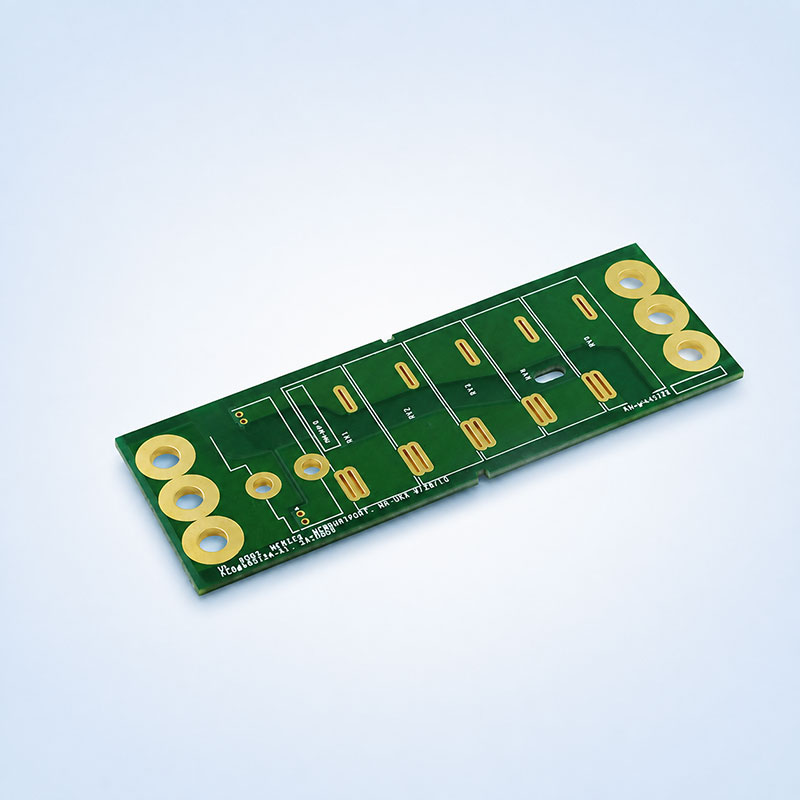
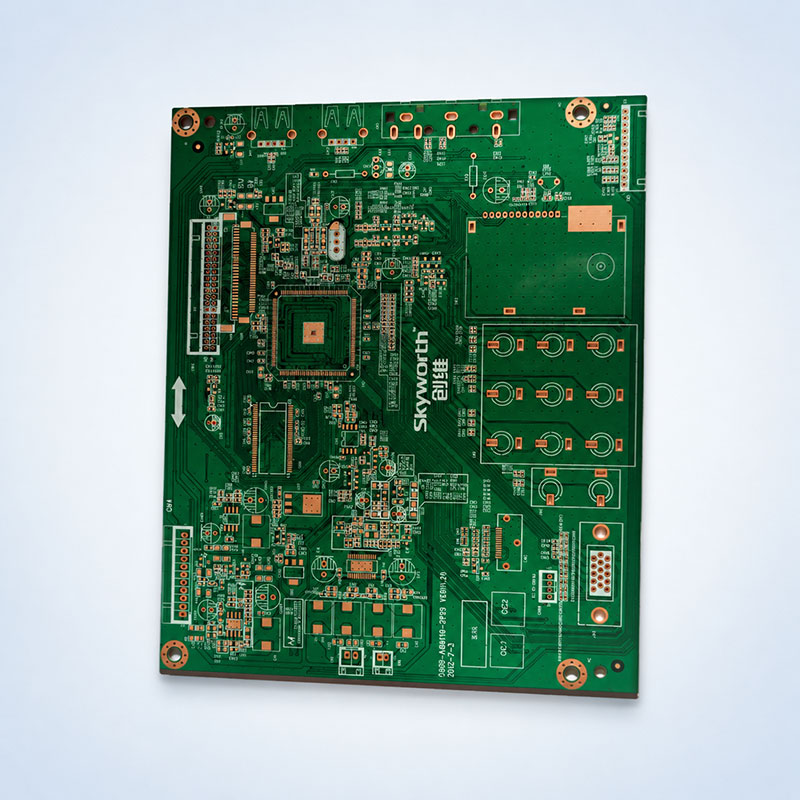
SugaMed manufactures HDI PCBs for medical electronics that require higher routing density, laser-drilled microvias, fine-pitch component fan-out, controlled impedance, and sequential build-up structures.
We support HDI PCB projects from engineering review and stack-up confirmation through PCB fabrication, inspection, electrical testing, and subsequent PCB assembly when required.
- 0.10 mm laser-drilled microvias
- 1+N+1, 2+N+2, and 3+N+3 HDI structures
- Blind, buried, and via-in-pad structures
- ISO 13485:2016 quality management system
When Does a Medical PCB Design Need HDI?
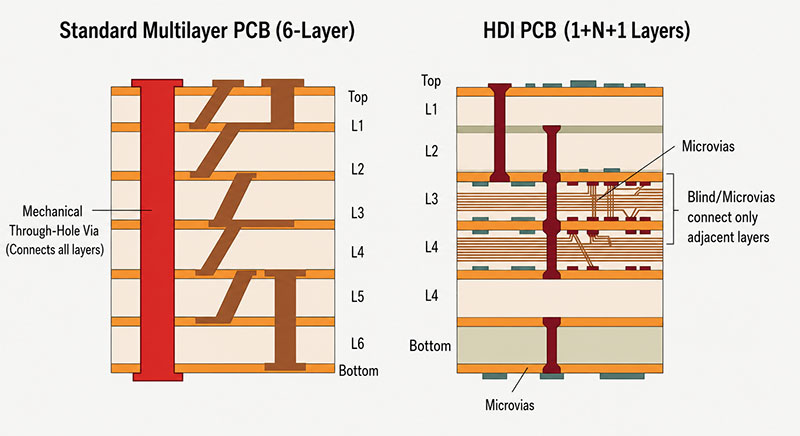
HDI is more than simply adding layers to a multilayer PCB. It uses microvias and build-up structures to create routing options that conventional through-hole construction may not provide.
Limited PCB Routing Space
As component count and I/O density increase, routing can become difficult within a fixed PCB outline. Conventional through vias occupy pad and antipad space on every layer they pass through, even when an electrical connection is not required on those layers.
Microvias connect only the layers that need to be connected, preserving routing channels elsewhere in the stack-up. When increasing the PCB outline is not practical, HDI can provide additional routing flexibility.
Fine-Pitch BGAs and High-Density Packages
High-I/O processors, memory devices, and fine-pitch BGAs can create fan-out constraints that are difficult to resolve with conventional through vias.
Laser microvias and via-in-pad structures provide additional routing options beneath dense packages. Package pitch alone, however, does not determine whether HDI is necessary. The actual ball map, available routing channels, and layer allocation should also be evaluated.
Higher Routing Density
Some designs simply require more interconnections within a limited PCB area.
Build-up structures allow signals to transition between adjacent layers without requiring a via to pass through the entire PCB. This can reduce congestion around dense component areas and provide additional routing options without automatically adding more conventional core layers.
Compact or Thin PCB Construction
When enclosure dimensions limit PCB area or finished board thickness, continuously adding conventional routing layers may not be the most practical approach.
HDI can provide more efficient interconnection within a compact stack-up, although the benefit should always be weighed against the additional cost and process complexity of sequential lamination.
HDI Structures We Manufacture
The appropriate HDI structure depends on how many build-up layers are required, which layers the microvias need to connect, and whether stacked, staggered, or buried interconnections are needed.
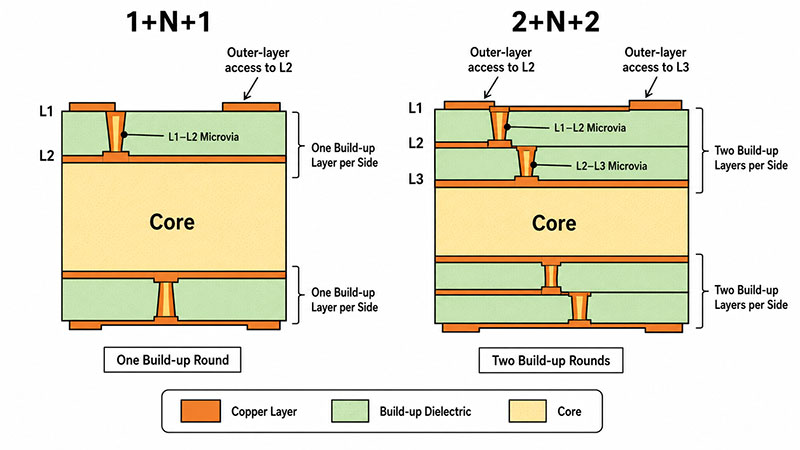
A 1+N+1 structure adds one build-up layer to each side of a central multilayer core, creating one microvia tier on each side of the PCB.
It is often the first HDI structure considered when a design requires microvia-based fan-out but does not need interconnection through multiple build-up layers.
When a single microvia tier provides sufficient routing access, 1+N+1 can avoid additional sequential lamination cycles and keep the manufacturing process relatively straightforward.
Learn more about 1+N+1 vs. 2+N+2 HDI stack-ups
A 2+N+2 structure adds two build-up layers to each side of the central core.
The additional microvia tier provides access to another routing layer. This can be useful when a single build-up layer cannot complete package fan-out or when an outer internal layer needs to remain available as a reference or power plane.
Because the second build-up stage adds lamination, laser drilling, plating, and inspection steps, 2+N+2 should be selected when the layout actually requires it rather than simply because it represents a more complex HDI construction.
A 3+N+3 structure adds three build-up layers to each side of the central core, providing additional routing tiers for designs with more complex interconnect requirements.
The additional build-up stages increase manufacturing complexity and place tighter demands on registration, microvia formation, copper filling, and inspection. Final manufacturability therefore depends on the complete stack-up, via geometry, material system, and routing architecture.
Blind microvias
connect an outer layer to an adjacent inner layer without passing through the entire PCB.
Buried vias
connect internal layers and are not exposed on either outer surface.
Via-in-pad
places a via directly within a component pad, creating additional routing access beneath dense packages.
Filled and capped vias
are filled and planarized before the pad or subsequent copper structure is completed.
Staggered microvias
use offset microvias between successive build-up layers.
Stacked microvias
align microvias vertically across successive build-up layers and therefore require tighter control of filling, plating, and interlayer registration.
The interconnect structure should be selected according to the actual routing requirement rather than treated as a default feature of every HDI PCB.
Medical HDI PCB Fabrication Capabilities
The table below summarizes our standard HDI PCB fabrication range. Final manufacturability depends on the combined requirements for trace width, copper thickness, microvia geometry, dielectric thickness, stack-up, and material system.
A single capability value does not determine whether an HDI design is manufacturable. For example, a 0.10 mm microvia that is straightforward in one dielectric construction may require adjustment in another.
For this reason, we recommend reviewing the complete stack-up and via structure before the design is released for fabrication.
| Parameter | Standard Capability | Additional Review |
|---|---|---|
| HDI Structure | 1+N+1 / 2+N+2 / 3+N+3 | Complex structures reviewed by stack-up |
| Laser Microvia | 0.10 mm minimum drill | Smaller geometry subject to review |
| Microvia Capture Pad | 0.25 mm | 0.20 mm subject to design review |
| Minimum Trace / Space | 2.5 / 2.5 mil | Down to 2 / 2 mil subject to design and copper requirements |
| Mechanical Drill | 0.20 mm minimum | Project dependent |
| Blind Microvia Aspect Ratio | Up to 1:1 | Depends on dielectric thickness and via geometry |
| Via Types | Blind / Buried / Via-in-Pad | Stack-up dependent |
| Microvia Configuration | Staggered / Stacked | Stacked structures require stack-up review |
| Via-in-Pad | Filled, planarized, and copper capped | According to pad and assembly requirements |
| Layer Count | Typical HDI builds: 4–16 layers | Higher layer counts reviewed by stack-up |
| Controlled Impedance | ±10% | Tighter tolerance subject to stack-up and coupon review |
| Base Materials | FR-4 / High-Tg FR-4 | Polyimide and selected low-loss material systems where required |
| Surface Finish | ENIG / Immersion Silver | Other finishes according to project requirements |
| Board Thickness | 0.6–3.2 mm | Custom thickness subject to stack-up review |
| Electrical Test | 100% electrical test | Flying probe or fixture-based testing |
| Optical Inspection | Inner- and outer-layer AOI | Additional inspection according to project requirements |
HDI Structure
Standard Capability
1+N+1 / 2+N+2 / 3+N+3
Additional Review
Complex structures reviewed by stack-up
Laser Microvia
Standard Capability
0.10 mm minimum drill
Additional Review
Smaller geometry subject to review
Microvia Capture Pad
Standard Capability
0.25 mm
Additional Review
0.20 mm subject to design review
Minimum Trace / Space
Standard Capability
2.5 / 2.5 mil
Additional Review
Down to 2 / 2 mil subject to design and copper requirements
Mechanical Drill
Standard Capability
0.20 mm minimum
Additional Review
Project dependent
Blind Microvia Aspect Ratio
Standard Capability
Up to 1:1
Additional Review
Depends on dielectric thickness and via geometry
Via Types
Standard Capability
Blind / Buried / Via-in-Pad
Additional Review
Stack-up dependent
Microvia Configuration
Standard Capability
Staggered / Stacked
Additional Review
Stacked structures require stack-up review
Via-in-Pad
Standard Capability
Filled, planarized, and copper capped
Additional Review
According to pad and assembly requirements
Layer Count
Standard Capability
Typical HDI builds: 4–16 layers
Additional Review
Higher layer counts reviewed by stack-up
Controlled Impedance
Standard Capability
±10%
Additional Review
Tighter tolerance subject to stack-up and coupon review
Base Materials
Standard Capability
FR-4 / High-Tg FR-4
Additional Review
Polyimide and selected low-loss material systems where required
Surface Finish
Standard Capability
ENIG / Immersion Silver
Additional Review
Other finishes according to project requirements
Board Thickness
Standard Capability
0.6–3.2 mm
Additional Review
Custom thickness subject to stack-up review
Electrical Test
Standard Capability
100% electrical test
Additional Review
Flying probe or fixture-based testing
Optical Inspection
Standard Capability
Inner- and outer-layer AOI
Additional Review
Additional inspection according to project requirements
DFM Review for Medical HDI PCB Designs
HDI fabrication introduces more interdependent process variables than conventional multilayer PCB construction. Microvia depth affects drilling geometry, build-up thickness affects via reliability, and adding another microvia tier can require an additional lamination cycle.
Our engineering review focuses on combinations of parameters that affect actual manufacturability rather than evaluating individual dimensions in isolation.
Microvia Geometry
We review the proposed microvia diameter together with dielectric thickness, capture-pad geometry, and the required connection depth.
The objective is to confirm that the proposed via structure is compatible with the fabrication process before the stack-up is finalized.
Stacked and Staggered Microvias
When multiple build-up layers are required, we evaluate whether microvias should be stacked or staggered.
A stacked structure can provide a direct vertical interconnection path but places greater demands on copper filling, cap plating, and registration between successive build-up stages. If a staggered structure can satisfy the routing requirement, the additional complexity of stacking may not be necessary.
Via-in-Pad Requirements
For via-in-pad designs, the review considers filling, planarization, copper capping, and the final pad condition required for assembly.
This is particularly important when the microvia is positioned directly beneath a BGA or another fine-pitch component termination.
BGA Fan-Out Routing
The need for HDI should be confirmed from the actual package fan-out.
We evaluate whether conventional routing, 1+N+1, or additional build-up layers are required to reach the available routing channels without unnecessarily increasing stack-up complexity.
HDI Stack-Up
The review covers the build-up sequence, core construction, dielectric layers, copper distribution, and the number of sequential lamination cycles.
For 2+N+2 and 3+N+3 structures, each additional build-up stage must be considered as part of the complete manufacturing sequence.
Controlled Impedance
When controlled impedance is specified, we review the proposed trace geometry together with dielectric thickness, copper thickness, and material properties.
Impedance requirements should be included in the fabrication drawing or stack-up documentation rather than added after the PCB construction has already been finalized.
Materials and Finished Board Thickness
The material system must support the required microvia process as well as the electrical and thermal requirements of the product.
We review laminate selection, Tg requirements where applicable, build-up dielectric thickness, copper construction, and finished board thickness as one complete stack-up rather than as independent specifications.
Manufacturing and Inspection Controls for Medical HDI PCBs
HDI fabrication capability is only one part of a medical electronics project. Released design data, materials, production records, and inspection criteria also need to remain controlled from one production build to the next.
Controlled Manufacturing Documentation
Production is based on released and approved manufacturing data, which may include:
- Gerber or ODB++ data
- Drill files
- Approved stack-up
- Fabrication drawings
- Impedance requirements
- Revision information
- Customer-specific fabrication notes
When a design revision changes, manufacturing documentation is updated through the applicable document-control process rather than being changed informally on the production floor.
Material and Lot Control
Laminates and other specified PCB materials are managed according to approved project requirements.
Where a material substitution could affect the released specification, it should be reviewed rather than introduced automatically—particularly when dielectric properties, thermal performance, or impedance depend on the specified material system.
Production and material records are maintained according to the applicable project traceability requirements.
HDI Process Inspection
Inspection points are focused on areas of the HDI process that become difficult or impossible to inspect after subsequent lamination.
Depending on project requirements, these controls may include:
- Inner-layer AOI
- Outer-layer AOI
- Microvia and plating inspection
- Cross-section analysis where specified
- 100% electrical testing
- Impedance verification where required
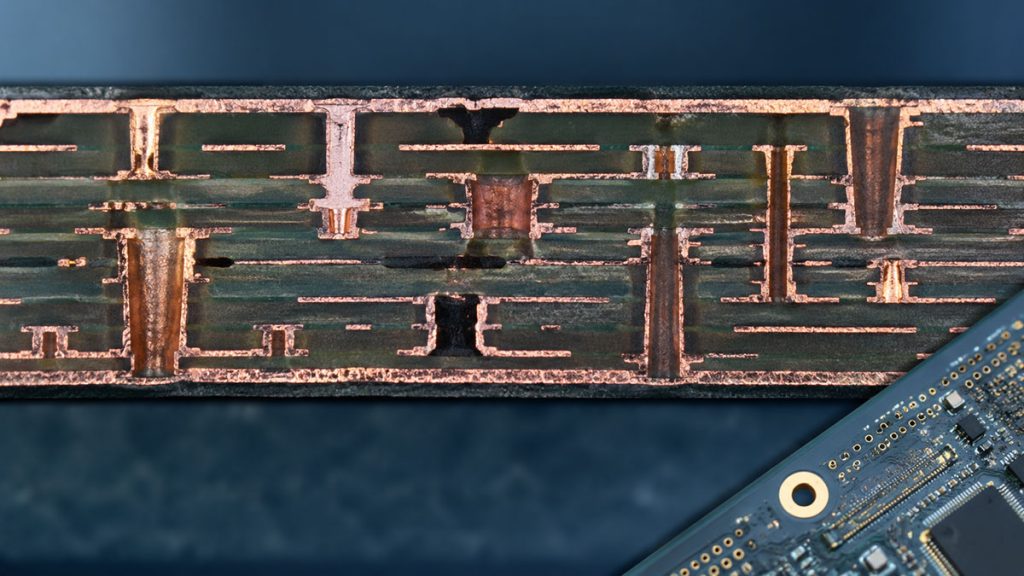
For stacked microvias and other complex structures, cross-section analysis can be particularly useful for evaluating plating quality, fill quality, and interlayer registration in the finished board.
IPC Acceptance Requirements
A medical PCB does not automatically require IPC Class 3.
The applicable acceptance class and workmanship requirements should be determined from the intended use of the product, reliability requirements, risk assessment, customer specifications, and approved project documentation.
Some medical electronics may be manufactured to IPC Class 2, while projects with higher reliability requirements may specify IPC Class 3 or additional customer-defined acceptance criteria.
Suga Electronics (Dongguan) operates an ISO 13485:2016 quality management system with a certification scope covering design support, fabrication, and assembly of PCBs for use in medical devices. ISO 13485 governs the quality management system and manufacturing processes; it does not by itself determine the IPC class required for an individual PCB.
HDI PCBs for Compact and High-Density Medical Electronics
HDI becomes relevant to medical electronics when the PCB architecture creates a genuine density or interconnection problem. The fact that a PCB is used in a medical product does not automatically make HDI necessary.
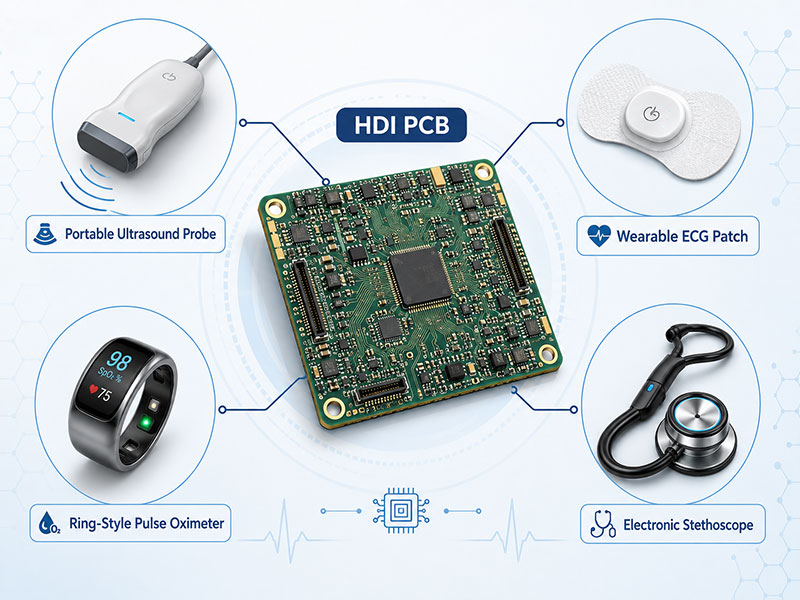
Space-Constrained PCB Designs
Some medical electronics have a fixed enclosure size or limited PCB area while still requiring processing, sensing, communication, and power-management circuitry on the same assembly.
When component density increases faster than the available PCB area, microvia-based routing can preserve routing channels that would otherwise be occupied by conventional through vias.
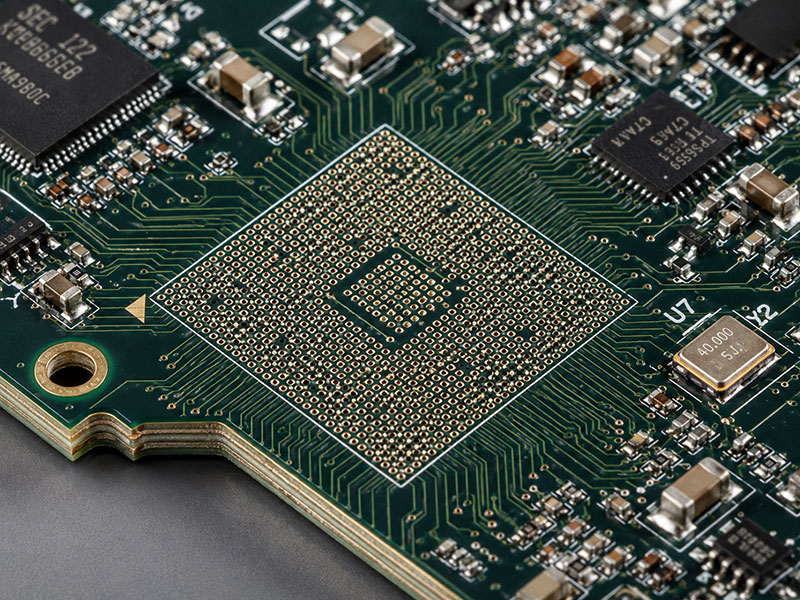
High-I/O Processor and BGA Boards
Processors, FPGAs, memory devices, and other high-I/O packages can concentrate a large number of connections within a relatively small component footprint.
HDI provides additional fan-out routing options around these packages through microvias, via-in-pad, and build-up layers.
Whether 1+N+1 or a multi-tier build-up structure is required should be determined from the actual fan-out analysis rather than package pitch alone.

High-Speed and Mixed-Signal Designs
Medical electronic PCBs may combine sensor interfaces, analog circuitry, processing devices, memory, and communication functions within the same constrained layout.
HDI does not automatically improve signal integrity. Its interconnect structure can, however, provide routing options that help engineers preserve reference planes, reduce unnecessary through-via stubs, and organize dense routing more effectively.
These requirements may appear in patient-monitoring, diagnostic, imaging, portable, wearable, and other medical electronic systems.
Is HDI the Right PCB Construction for Your Design?
HDI solves a specific problem: interconnect density.
It should not be selected simply because a PCB is complex, used in a medical product, has a high layer count, or requires high performance. Other PCB technologies may address the actual design requirement more directly.
These technologies are not always mutually exclusive. A PCB may, for example, require both an HDI interconnect structure and a High-Tg laminate.
The first question should therefore be which design constraint needs to be solved, rather than which PCB technology sounds more advanced.
| Primary Design Requirement | Construction or Material to Consider |
|---|---|
| Conventional routing density without a microvia requirement | Standard Rigid / Multilayer PCB |
| Dense BGA fan-out or microvia-based routing required | HDI PCB |
| PCB must bend, fold, or conform to an enclosure | Flex / Rigid-Flex PCB |
| High interconnect density combined with flexible sections | HDI Rigid-Flex, subject to stack-up review |
| Higher thermal requirements or repeated reflow exposure | High-Tg material, which can also be used in HDI construction |
| RF or low-loss signal requirements | RF / low-loss material system, which may also be combined with HDI |
Conventional routing density without a microvia requirement
Construction or Material to Consider
Standard Rigid / Multilayer PCB
Dense BGA fan-out or microvia-based routing required
Construction or Material to Consider
HDI PCB
PCB must bend, fold, or conform to an enclosure
Construction or Material to Consider
Flex / Rigid-Flex PCB
High interconnect density combined with flexible sections
Construction or Material to Consider
HDI Rigid-Flex, subject to stack-up review
Higher thermal requirements or repeated reflow exposure
Construction or Material to Consider
High-Tg material, which can also be used in HDI construction
RF or low-loss signal requirements
Construction or Material to Consider
RF / low-loss material system, which may also be combined with HDI
HDI PCB Engineering Resources
For engineering questions that go beyond the scope of a fabrication service page, the following guides provide more detail on relevant design decisions.
1+N+1 vs. 2+N+2 HDI Stack-Ups
A practical comparison of single- and two-tier build-up structures, including what changes when a second microvia tier is introduced and when the added manufacturing complexity may be justified.
What Materials Are Used for HDI PCBs?
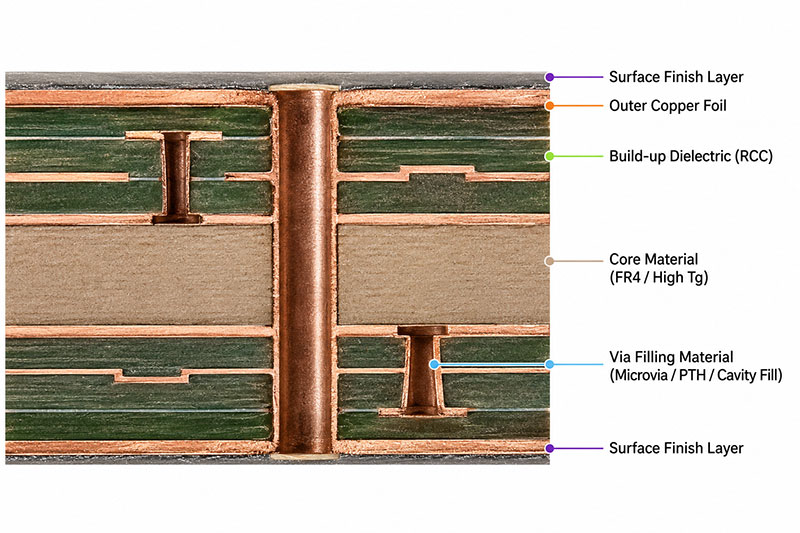
A closer look at HDI laminates, build-up dielectrics, copper, via-fill materials, solder mask, and surface finishes, and how these materials work together through sequential lamination and assembly.
What Is an HDI PCB, and When Does a Design Need One?
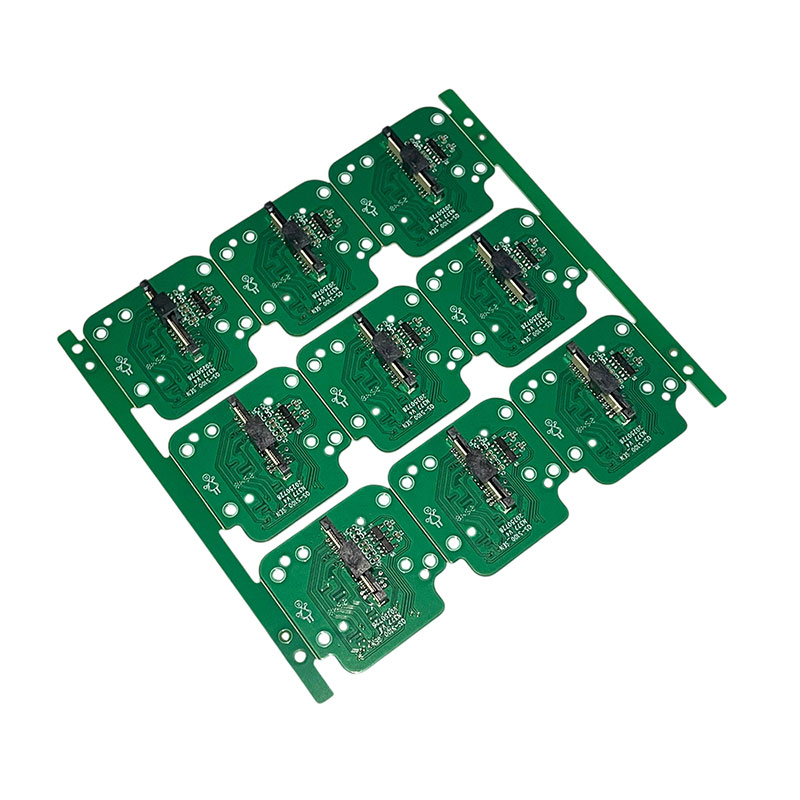
An introduction to microvias, blind vias, buried vias, via-in-pad, and the practical differences between HDI and conventional multilayer PCB construction.
HDI PCB FAQs
What HDI structures can SugaMed manufacture?
SugaMed supports 1+N+1, 2+N+2, and 3+N+3 HDI structures, as well as blind vias, buried vias, via-in-pad, staggered microvias, and stacked microvias.
The final manufacturable structure depends on the complete stack-up, microvia diameter, dielectric thickness, capture-pad geometry, and material system. Complex structures should be reviewed before the PCB layout is released for fabrication.
What is the minimum laser microvia size?
Our standard minimum laser drill size is 0.10 mm.
Microvia manufacturability cannot be determined from drill diameter alone. Dielectric thickness, capture-pad geometry, copper construction, via-fill requirements, and the number of build-up stages also need to be considered.
When should a medical PCB use HDI?
HDI should be considered when conventional PCB construction cannot efficiently provide the required routing density.
Typical reasons include limited routing area, dense BGA or high-I/O package fan-out, the need for microvias or via-in-pad, or routing that requires access through multiple build-up layers.
A medical product does not automatically require HDI simply because it is compact or has high reliability requirements.
Do medical HDI PCBs always require IPC Class 3?
No.
The required IPC class depends on the intended use of the product, reliability requirements, risk assessment, and contractual requirements.
Some medical electronics may be manufactured to IPC Class 2, while higher-reliability projects may require IPC Class 3 or customer-defined acceptance criteria. The required class should be stated in the approved project documentation.
Can HDI be combined with Rigid-Flex or High-Tg materials?
Yes, provided that the design requires both technologies and the combined stack-up is manufacturable.
HDI structures can be used in the rigid sections of some rigid-flex designs, while High-Tg materials can be selected for HDI PCBs that require the corresponding thermal performance.
The combined material and interconnect structure should be reviewed as one complete stack-up before fabrication.
What files are needed for an HDI PCB quotation?
For the most useful review, provide Gerber or ODB++ data, drill files, stack-up information, fabrication drawings, applicable impedance requirements, material requirements, and quantity.
If the stack-up has not yet been finalized, you can also send the available design information for an engineering feasibility review before release.
Start Your Medical HDI PCB Project
If you would like to request a quote for HDI PCBs or schedule an engineering review, please provide as much existing manufacturing data as possible.
Useful project files and information include:
- Gerber or ODB++ files
- Drill files
- Proposed stack-up
- Fabrication drawing
- Controlled-impedance requirements
- Specified materials or material restrictions
- Order quantity
- Applicable IPC or customer acceptance requirements
Our engineering team reviews the submitted data against the required HDI structure, microvia geometry, material system, and fabrication process before production requirements are finalized.