
It is not unusual to send the same Gerber files, BOM, and production quantity to three PCB assembly suppliers and receive three significantly different prices.
One supplier may offer the lowest price, another may be 20% higher, and a third may be as much as 40% higher. Faced with this gap, purchasing teams often ask first:
“Which quote is actually reasonable?”
The difference is often about more than the factory’s processing costs.

Even when all three suppliers receive the same project, their assumptions about component sourcing channels, PCB fabrication specifications, test coverage, one-time engineering charges, excess material handling, lead time, and shipping terms may not be the same.
So when comparing PCB assembly quotes, the first step is not to identify the lowest unit price. It is to confirm:
Are all three quotes based on the same project scope?
First, Confirm That All Three Suppliers Are Quoting the Same Scope
Suppose three suppliers provide the following unit prices:
- Supplier A: $10,000/PCBA / PCBA
- Supplier B: $15,000 / PCBA
- Supplier C: $20,000 / PCBA
Based on these figures alone, Supplier A is clearly the least expensive.
However, once the quotes are broken down, the situation may look very different:
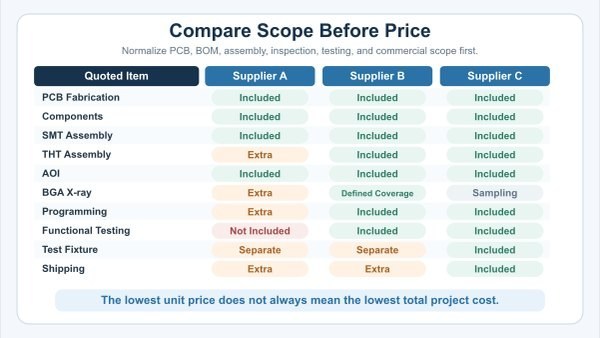
| Quoted Item | Supplier A | Supplier B | Supplier C |
|---|---|---|---|
| PCB Fabrication | Included | Included | Included |
| Components | Included | Included | Included |
| SMT Assembly | Included | Included | Included |
| THT Assembly | Extra | Included | Included |
| AOI | Included | Included | Included |
| BGA X-ray | Extra | Defined Coverage | Sampling |
| Programming | Extra | Included | Included |
| Functional Testing | Not Included | Included | Included |
| Test Fixture | Separate | Separate | Included |
| Shipping | Extra | Extra | Included |
At this point, the three unit prices are no longer directly comparable.
Supplier A has the lowest base unit price, but THT, programming, X-ray, or functional testing must be quoted separately. Supplier C appears to be the most expensive, but may already include more of the required work.
A more reliable approach is to normalize all three quotes to the same PCB, BOM, assembly, inspection, and testing scope, then compare the total cost of producing the same batch of finished products.
BOM Sourcing Often Creates the Largest Price Differences
For projects that include component sourcing, the BOM is usually one of the largest contributors to total cost.
Even when all three suppliers receive exactly the same BOM, their calculated component costs may still differ.
Component Sourcing Channels May Differ
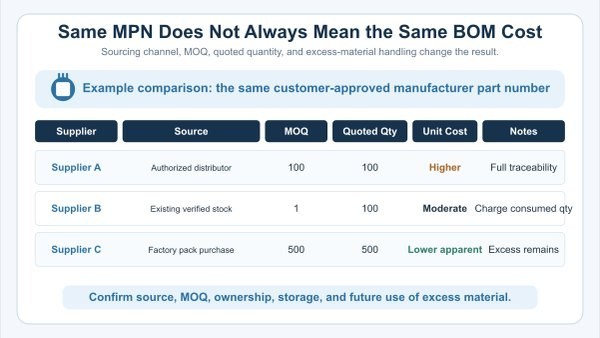
The same manufacturer part number may be sourced from the original manufacturer or an authorized distributor, a supplier’s existing inventory, another customer-approved source, or an independent distributor or spot market.
These channels can differ in price, lead time, traceability documentation, and supply risk.
If one supplier quotes based on authorized distribution while another already has internally verified inventory, a price difference is perfectly normal.
The more important question is:
What sourcing assumptions does each quote use, and do those sources meet the project’s purchasing and traceability requirements?
This is especially important for medical, industrial control, and other products with strict component-source requirements.
MOQ and Packaging Quantities May Be Handled Differently
This issue is particularly common in small-batch projects.
Suppose you need to build 100 PCBAs, with one specific IC per board. Actual production may require approximately 100 pieces plus a reasonable process-loss allowance, but the device may have a higher minimum order quantity or a standard packaging quantity.
Different suppliers may handle this commercially in different ways.
Some suppliers may include the full package quantity in the project cost. Others may already have the part in stock and charge only for the quantity consumed by the project. In some cases, excess material may be retained for a future repeat order.
There is no single rule that applies to every EMS or PCBA supplier.
The quote or purchasing terms should clearly state how excess components are charged, who owns them, how long they will be stored, and how they may be used later.
When two BOM costs differ significantly, confirm:
- Whether an MOQ or standard package quantity applies
- How many pieces are included in the quote
- Whether excess material will remain
- How excess material will be charged and managed
This information is often more useful than simply comparing the BOM total.
Alternative Component Strategies May Differ
If a specified component is unavailable, obsolete, or subject to an excessive lead time, suppliers may use different quoting assumptions.
Supplier A may quote strictly against the original MPN. Supplier B may quote an alternative part that has already been approved by the customer. Supplier C may suggest an alternative, but require technical approval before purchasing or production.
One important point must be avoided:
A supplier should not replace a critical MPN with a “similar” part simply to reduce the quote.
The use of alternatives should follow the customer’s AVL, BOM notes, engineering change process, or formal approval procedure.
This is particularly important for medical electronics projects with strict design controls.
Inventory and Market Conditions Also Affect Pricing
Electronic component availability changes with inventory levels and market conditions.
One factory may already have compliant inventory, while another must purchase the parts specifically for the project. For long-lead-time components, the purchasing cycle may also affect both the overall project schedule and the final price.
Therefore, component sourcing should not be evaluated only as:
BOM Total = $X
You should also review the MPNs, sourcing channels, actual purchase quantities, and quote validity period.
The Same Gerber Files Do Not Necessarily Mean the Same Bare PCB Quote
Gerber files define the manufacturing artwork, but they do not always contain the complete PCB fabrication requirements.
If the customer provides only Gerber files and does not clearly specify the material, copper thickness, board thickness, surface finish, impedance requirements, or other details in the fabrication drawing, stackup, or purchasing specification, different factories may quote based on different manufacturing assumptions.
Key items to verify typically include:
- Laminate / material requirements
- Tg requirements, if specified
- Copper thickness
- Finished board thickness
- Surface finish
- Controlled impedance
- Via structure
- Stackup
- Panelization requirements
- Special drilling, trace, or tolerance requirements
For relatively standard 2-layer or 4-layer FR-4 boards, some specification differences may have only a limited effect on cost.
However, if the project involves HDI, blind or buried vias, rigid-flex construction, heavy copper, special materials, or tighter manufacturing tolerances, differences in fabrication scope can have a significant impact on price.
Before comparing quotes, confirm that all suppliers are quoting against the same PCB revision and the same fabrication specifications.
If the specifications themselves differ, the PCB costs are naturally not directly comparable.
Why Can Assembly Prices Also Differ?
Even when the PCB and BOM are standardized, suppliers may still quote different assembly costs.
The difference usually depends on the actual production workload, process flow, and each supplier’s manufacturing setup.
A Small PCB Is Not Necessarily Cheaper to Assemble
For SMT assembly, board size is only one factor.
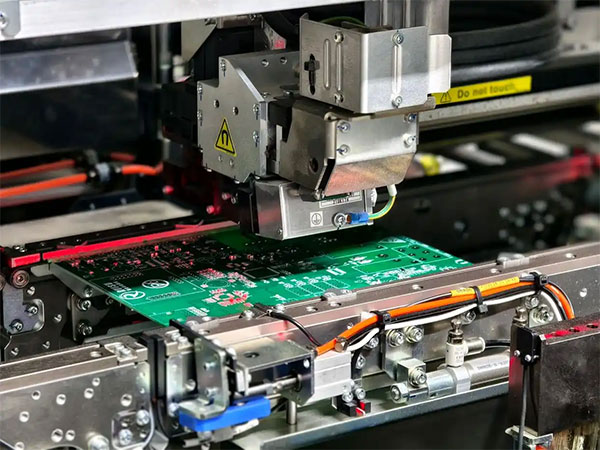
The factory must also evaluate the component count, placement count, single-sided or double-sided SMT, package mix, fine-pitch devices, and components such as BGAs, QFNs, LGAs, 01005s, THT parts, and odd-form components.
If the project also includes hand soldering or additional assembly work, the workload increases further.
A relatively small PCB with more than 200 components, double-sided SMT, BGA and fine-pitch QFN devices, and multiple through-hole connectors may require more assembly and inspection work than a larger control board with fewer components.
Assembly cost should not be estimated from PCB length and width alone.
Double-Sided SMT Usually Adds Process Steps
For a typical double-sided reflow assembly, the PCB generally requires solder paste printing, placement, and reflow-related operations on both sides.
The actual process route still depends on the component distribution on each side, package types, thermal mass, and the supplier’s manufacturing method.
Double-sided SMT usually adds process steps and equipment time, but it should not simply be calculated as “single-sided price × 2.”
Differences in equipment configuration, changeover efficiency, and batch size can also affect the final assembly quote.
THT and Manual Operations Are Common Sources of Quote Gaps
Some quick quotes cover mainly SMT and do not fully include through-hole parts, connectors, cables, or special manual operations.
A real project may include SMT, through-hole connectors, selective or manual soldering, cable or connector assembly, and programming.
If Supplier A quotes only the SMT work while Supplier B includes all of these operations, their unit prices cannot be compared directly.
The RFQ should define the complete assembly scope rather than simply stating:
“Please quote PCB assembly.”
Inspection and Testing Must Be Compared Separately
This is one of the areas most likely to create ambiguity in a quote.
AOI, X-ray, ICT, and FCT are not the same type of work.
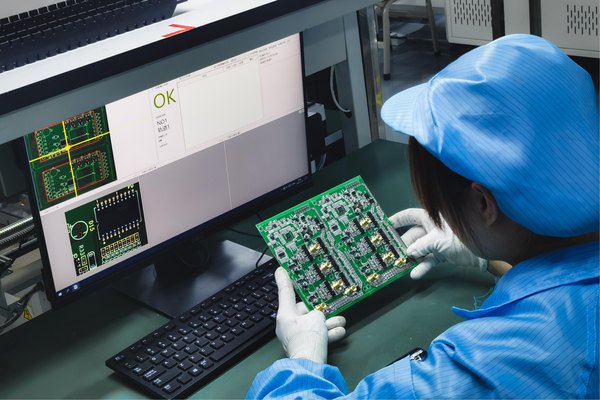
SPI, AOI, and X-ray are used for different types and stages of manufacturing inspection. ICT focuses more on electrical checks of circuit nodes, components, and assembly defects. FCT verifies board-level or product-level functionality under defined operating conditions.
If a quote only states:
“Inspection / Testing Included”
there is still not enough information to make a meaningful comparison.
A more useful comparison looks like this:
| Inspection / Test | Supplier A | Supplier B |
|---|---|---|
| SPI | Included | Included |
| AOI | 100% | 100% |
| BGA X-ray | Sampling | Defined Devices / Coverage |
| Programming | Extra | Included |
| ICT | Not Required | Not Required |
| FCT | Extra | Included |
| Test Fixture | Customer Provides | Quoted Separately |
| Test Records | Basic | Per Project Requirement |
Compare X-ray Coverage, Not Just Whether X-ray Is Included
For devices such as BGAs, whose bottom-side solder joints cannot be fully inspected optically, X-ray can be used to examine hidden solder joints.
However, this does not mean that every project requires 100% X-ray inspection of every device.
The quote should specify which packages require inspection, whether the inspection is first-article, sampling, or 100%, and whether the customer has defined acceptance criteria.
If one project requires 100% BGA X-ray while another quote is based only on sampling, the cost basis is clearly different.
Do Not Evaluate FCT Based Only on “Included”
The actual workload for functional testing depends on how the test is defined.
Confirm the test specification, fixture, firmware or test software, test time per board, test coverage, pass/fail criteria, and whether test data must be retained.
A simple power-on check and an FCT process using a dedicated fixture, automated test software, and data logging should not be treated as the same testing cost.
Different NRE and Tooling Structures Can Distort the Apparent Unit Price
NRE stands for Non-Recurring Engineering. It refers to engineering or tooling costs incurred during project setup that generally do not recur for every PCBA produced.
Depending on the supplier’s quoting method, NRE may include SMT stencils, engineering or program setup, programming setup, inspection program preparation, test program development, ICT or FCT fixtures, and other project-specific tooling.
One point is important:
Not every supplier will charge these items separately.
Some factories list them under NRE. Others include them in the unit price. Some use different pricing methods depending on the production quantity and project complexity.
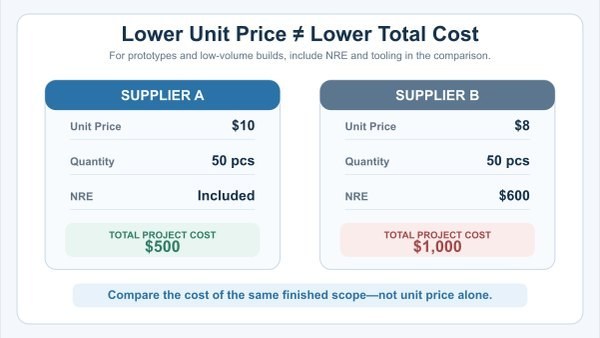
For example:
Supplier A
Unit Price: $10 NRE: Included
Supplier B
Unit Price: $8 NRE: $600
For an order of only 50 pieces:
Supplier A:
50 × $10 = $500
Supplier B:
50 × $8 + $600 = $1,000
Although Supplier B has the lower unit price, its total cost for the first build is higher.
If the quantity increases to 1,000 pieces, the result may be different.
For this reason, prototype and low-volume projects should compare unit price and one-time charges separately.
You should also confirm whether these charges can be reused for future repeat orders.
If there are no changes affecting the reuse of the PCB revision, panel, program, fixture, or test method, some tooling and programs may remain valid. If the design or test scope changes, they must be reassessed. Do not assume that every NRE charge will always be a one-time cost.
Different Lead Times May Also Reflect Different Quote Definitions
Supplier A quotes three weeks.
Supplier B quotes ten days.
At first glance, Supplier B appears to be much faster.
Before comparing the two figures, confirm:
From which milestone does the lead time begin?
Different suppliers may start counting from PO confirmation, closure of engineering questions, approval of manufacturing files, component availability, or production release.
For example, one supplier’s “10 days” may refer only to assembly lead time after all components and PCBs are available. Another supplier’s “3 weeks” may include PCB fabrication, component sourcing, assembly, and testing.
These two figures cannot be compared directly.
Expedited projects may also involve additional component expediting, production priority, engineering setup, or express logistics charges.
When comparing quotes, review the lead-time definition together with the price.
Which Costs May Need to Be Confirmed Separately Before Production?
Some projects do not include enough engineering information at the initial RFQ stage to determine every cost immediately.
This does not necessarily mean the supplier is adding a “hidden fee.”
The more important issue is to distinguish between items already included in the current quote and items that remain subject to engineering confirmation.
Common examples include:
- Stencil / tooling
- Programming
- Test fixtures
- Component MOQ
- Excess material
- Rework or reprogramming caused by approved changes
- Conformal coating
- Special packaging
- Shipping
- Import duties
- Customer-specific reports or documentation
If these activities are required parts of the project, they should ideally be confirmed consistently before selecting a supplier.
Otherwise, you may end up with:
The lowest base quote, but not the lowest total project cost.
What Else Should You Compare in a Medical PCB Assembly Quote?
For medical electronics projects, confirming only the PCB, BOM, and assembly price is not enough.
Two suppliers may both claim to support medical PCB assembly, but that does not mean their quotes include the same quality controls, traceability, or documentation requirements.
First, Confirm the Project’s Acceptance Requirements
Clarify the customer-defined workmanship requirements, the IPC acceptance criteria specified in the contract, inspection coverage, special process controls, and any other customer acceptance requirements.
IPC-A-610 provides acceptance criteria for electronic assemblies. The applicable acceptance class and requirements should be defined in the project documentation, purchasing requirements, or agreement between the customer and supplier. They should not be assumed solely because the product is used in medical equipment.
Then Confirm the Traceability Scope
Different medical projects may require different levels of traceability.
Requirements may include production lot traceability, component lot or date-code traceability, serial-number traceability, and related material or process records.
Not every medical PCBA project requires the same depth of traceability.
If Supplier A quotes basic lot traceability while Supplier B includes more detailed component and serial-number traceability in its manufacturing process, the actual work covered by the two quotes is different.
ISO 13485 Does Not Replace Project Scope Definition
ISO 13485 is a quality management system standard for the medical device industry.
It indicates that a company operates under an applicable quality management system, but it does not automatically define:
- Which IPC class should apply to the PCBA
- Which BGAs require 100% X-ray
- Whether ICT is required
- Which functions must be tested during FCT
- Which test data must be retained for each board
These requirements still need to be defined through customer requirements, design risk, manufacturing documentation, and the agreed quality plan.
Therefore, instead of asking only:
“Do you have ISO 13485?”
it is more useful to confirm:
What inspection, testing, traceability, and documentation scope is included in the quote for this specific project?
How Can You Make Quotes Truly Comparable?
After receiving quotes from several suppliers, review them across the following five areas.
PCB: Confirm that the PCB revision, material or stackup, copper thickness, surface finish, quantity, and special requirements are the same.
BOM: Confirm that the BOM revision, MPNs, approved alternatives, sourcing channel, MOQ, and excess-material handling are consistent. Also check whether any components remain unquoted or subject to confirmation.
Assembly: Confirm that SMT, THT, manual assembly, programming, and special processes are all calculated against the same requirements.
Inspection & Testing: Compare SPI, AOI, X-ray coverage, ICT, FCT, test fixtures, and test records. Do not look only at whether an item is “included”; review the actual coverage.
Commercial Terms: Finally, compare unit price, NRE, shipping, lead time, payment terms, quote validity, and Incoterms.
Only when the technical and service scopes are substantially aligned do the final commercial figures become meaningfully comparable.
A Simple PCB Assembly Quote Comparison Example
Suppose a medical control board project requires 100 pieces.
The customer sends the same revision of the Gerber files and BOM to three suppliers and receives the following quotes:
| Item | Supplier A | Supplier B | Supplier C |
|---|---|---|---|
| PCB | Included | Included | Included |
| Components | Included | Included | Included |
| SMT / THT | Included | SMT Only | Included |
| AOI | Included | Included | Included |
| BGA X-ray | Defined Coverage | Extra | Sampling |
| Programming | Included | Extra | Included |
| FCT | Included | Extra | Included |
| Fixture | $300 | $250 | Included |
| Shipping | Extra | Extra | Included |
Supplier B may have the lowest base unit price.
However, after adding THT, programming, X-ray, FCT, the fixture, and shipping according to the actual project requirements, its total project cost may be close to or even higher than the other two suppliers.
That is why PCBA comparison should not stop at “How much does each board cost?”
The more meaningful comparison is the total cost required to deliver the same conforming product scope.
What Should You Check When a Quote Is Significantly Lower?
A low price is not automatically a problem.
A supplier may have better inventory, higher production efficiency, more suitable equipment, or a different commercial cost structure.
If one quote is significantly lower than the others, the key question is where the difference comes from.
Pay particular attention to:
- Whether the BOM revision, MPNs, and approved alternatives are the same
- Whether all components and MOQs are included
- Whether the PCB fabrication specifications are the same
- Whether the SMT / THT scope is complete
- Whether the AOI, X-ray, and testing scope is the same
- Whether programming and NRE / tooling are charged separately
- Whether the lead time is defined from the same starting point
- Whether shipping and Incoterms are the same
If these conditions are confirmed to be consistent, the lower quote may be entirely reasonable.
A low price is not the risk. A quote that is significantly lower but cannot clearly explain the source of the difference deserves closer review.
How Should You Prepare an RFQ So That Supplier Quotes Are Comparable?
The most effective way to reduce quote differences is not to ask repeated questions after receiving the quotes. It is to reduce ambiguity in the initial RFQ.
At a minimum, prepare:
- Gerber files
- BOM with manufacturer part numbers
- Pick-and-place / centroid file
- Assembly drawing
- PCB fabrication specification / stackup, if applicable
- Build quantity
- Programming requirements
- Inspection requirements
- Testing requirements
- Traceability requirements
- Target lead time
If the medical project has defined workmanship requirements, record-retention requirements, serial-number traceability, or specific testing requirements, include them in the RFQ package whenever possible.
Then send the same revision of the RFQ package to every candidate supplier.
This significantly reduces the assumptions each supplier must make and makes the quotes much easier to compare.
Frequently Asked Questions
Why do different PCB assembly suppliers quote different prices for the same Gerber files and BOM?
Gerber files and the BOM define only part of the project.
PCB fabrication specifications, component sourcing channels, MOQs, alternatives, assembly scope, inspection, testing, NRE, lead time, and logistics terms can all affect the final quote.
Before comparing prices, confirm that these conditions are consistent.
Is the cheapest PCB assembly quote worth choosing?
Price alone does not determine whether a supplier is suitable.
If the lower quote uses the same PCB, BOM, assembly, inspection, testing, and commercial scope as the other suppliers, the lower price is clearly an advantage.
If the lower price results from omitted work, add those items first and then compare the total project cost.
Why can BOM costs vary so much between suppliers?
Common reasons include differences in MPNs, sourcing channels, existing inventory, MOQs, packaging quantities, approved alternatives, and excess-material handling.
When comparing BOM costs, confirm the sourcing assumptions instead of looking only at the final total.
What should a PCB assembly quote generally include?
Quote formats vary between suppliers.
Depending on the service scope, a quote may include PCB fabrication, component sourcing, SMT / THT assembly, inspection, programming, testing, and NRE / tooling.
The goal is not to make every quote look identical. The goal is to confirm that the final scope is the same.
Will NRE be charged again for a repeat order?
Not necessarily.
If the PCB revision, panel, program, fixture, and testing requirements do not affect the reuse of existing tooling or programs, some NRE may not recur.
If the design, production method, or test scope changes, the costs should be reassessed.
How can I make quotes from three PCB assembly manufacturers easier to compare?
Send every supplier the same RFQ package, production quantity, quality requirements, and testing requirements.
Clearly define the PCB, BOM, assembly, inspection, testing, traceability, lead time, and commercial scope. This will significantly reduce differences caused by supplier assumptions.
Before Comparing PCB Assembly Quotes, Make Sure the Scope Is the Same
When several PCB assembly manufacturers quote very different prices, do not immediately decide which supplier is expensive or inexpensive.
Break down the quotes first.
Confirm that the PCB revision and fabrication specifications are the same, that the BOM and component sourcing methods are consistent, and that the assembly scope is complete. Review the coverage of AOI, X-ray, programming, and FCT, then check how NRE, fixtures, lead time, and shipping are calculated.
A meaningful PCB assembly quote comparison should be based on:
The same PCB, the same BOM, the same assembly scope, the same inspection and testing scope, and broadly comparable commercial terms.
Once these conditions are aligned, the prices become genuinely comparable.
If you already have the Gerber files, BOM, pick-and-place file, assembly drawing, expected quantity, and testing requirements, submit the complete RFQ package to a PCB assembly manufacturer for engineering review and a formal quotation.
Send Your Gerber & BOM for a PCB Assembly Quote