
When you are preparing to request a quote from a PCB assembly manufacturer, the first question is often not about price. It is: “What files do I need to provide?”
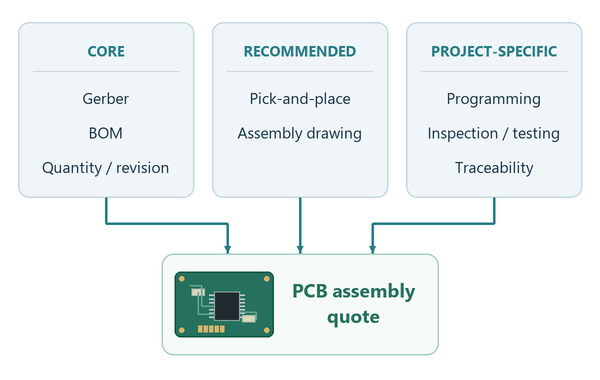
For most medical PCB assembly projects, Gerber files, a bill of materials (BOM), the quantities to quote, and basic assembly information are enough to start the initial discussion. Pick-and-place data, an assembly drawing, and programming, testing, or traceability requirements can then be added according to the complexity of the project.
However, being ready to request a quote is not the same as being ready for production.

If the project is still at the prototype PCB assembly or new product introduction (NPI) stage, you do not need to wait until every document is complete before contacting a manufacturer. In many cases, you can submit the available Gerber files, BOM, and basic project requirements first. The engineering team can then identify which missing details affect the quotation and which can be finalized before production release.
The more complete and consistent the file package, the easier it is for the supplier to assess PCB fabrication, component sourcing, assembly, inspection, and testing accurately. It also reduces repeated clarification during the quoting process.
Table of contents
- What Files and Information Are Typically Needed for a PCB Assembly Quote?
- 1. Gerber Files and PCB Fabrication Data
- 2. Which BOM Details Have the Greatest Impact on a PCB Assembly Quote?
- 3. Is a Pick-and-Place File Required for a Quote?
- 4. What Is the Purpose of an Assembly Drawing?
- 5. Why Must You Specify the Quantities to Quote?
- 6. What Additional Requirements Should Be Stated for a Medical PCB Assembly Project?
- 7. Can You Start a Quote with Only Gerber Files and a BOM?
- 8. Which File Problems Most Often Delay a PCB Assembly Quote?
- 9. What Happens After You Submit the Files?
- 10. Quick Checklist Before Sending a PCB Assembly RFQ
- Frequently Asked Questions
- Can I Request a PCB Assembly Quote Without a Pick-and-Place File?
- Do I Need an Assembly Drawing If I Already Have Gerber Files?
- Can I Use ODB++ Instead of Gerber?
- Does a Medical PCB Assembly Quote Have to Specify IPC Class 3?
- Do I Need a Complete Functional Test Procedure Before Requesting a Quote?
- What If My PCB Assembly Files Are Not All Ready Yet?
- What Is the Next Step Once Your Gerber Files and BOM Are Ready?
What Files and Information Are Typically Needed for a PCB Assembly Quote?
The following table provides a quick reference before you send a request for quotation (RFQ).
| File or information | Priority at the quoting stage | Main purpose |
|---|---|---|
| Gerber / PCB fabrication data | Core | Assess PCB fabrication specifications and board-level information relevant to assembly |
| BOM | Core | Identify component part numbers, quantities, sourcing needs, and material costs |
| Pick-and-place / centroid file | Recommended | Confirm SMT component locations, board side, and placement information |
| Assembly drawing | Recommended | Clarify component orientation, polarity, DNP locations, and special assembly instructions |
| PCB revision | Core | Confirm that all files refer to the same design revision |
| Quantities to quote | Core | Assess material costs, production setup, and unit pricing |
| IPC / assembly requirements | Project-specific | Define the applicable assembly acceptance criteria |
| Programming requirements | Project-specific | Assess programming and related operations |
| Inspection / test requirements | Project-specific | Define the scope of X-ray, ICT, functional testing, or other checks |
| Traceability requirements | Project-specific | Define required lot, component, serial-number, and test records |
| Target delivery date | Recommended | Assess whether procurement and production can meet the project schedule |
For a simple prototype, you may not need every item in the table before requesting an initial quote. Projects with complex BGA or QFN packages, through-hole components, programming, functional testing, or special quality requirements usually need more detail before the scope can be confirmed.
1. Gerber Files and PCB Fabrication Data
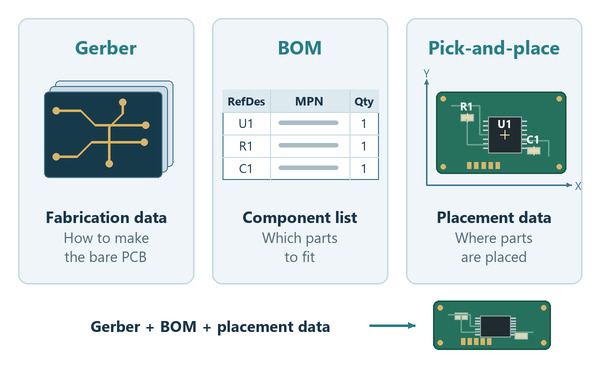
Gerber is a widely used data exchange format for PCB fabrication. It describes graphical information such as copper, solder mask, and silkscreen layers. Together with drill data, the board outline, and other fabrication instructions, these files form the PCB manufacturing data package.
If the same supplier is responsible for both bare-board fabrication and assembly, as in a turnkey PCB assembly project, Gerber files and the related fabrication information are a key basis for the quote.
For any PCB, confirm the layer count, drill and outline data, and basic fabrication specifications, including material, board thickness, copper weight, and surface finish. More complex constructions may also require a detailed stack-up. If the design includes controlled impedance, HDI, special hole structures, or other nonstandard processes, provide the relevant stack-up, fabrication drawing, or engineering notes.
The Common Problem Is Not Whether Gerber Files Exist, but Whether the Revision Is Correct
During quotation, conflicting information between files can be harder to resolve than a single missing file.
Typical examples include:
- Gerber files updated to Rev B while the BOM is still at Rev A;
- an assembly drawing that has not been updated after a board-outline change;
- drill data from an older design revision;
- special board thickness, copper weight, or surface-finish requirements mentioned only in an email rather than included in the controlled project documentation;
- multiple folders or files labeled “Final.”
At the prototype stage, these inconsistencies can delay the quotation and create extra clarification work. If they carry over into repeat production, they can also become a manufacturing risk.
Before sending the package, confirm that the Gerber files, BOM, pick-and-place data, and assembly drawing all use the same project revision identifier.
2. Which BOM Details Have the Greatest Impact on a PCB Assembly Quote?
Gerber data tells the manufacturer how to fabricate the PCB. The BOM identifies the components that need to be installed on it.
The BOM is one of the most important documents for estimating the material cost of a PCB assembly. A quote-ready BOM should normally include:
- reference designator;
- quantity;
- manufacturer;
- manufacturer part number (MPN);
- description or value;
- package;
- do-not-populate (DNP) status;
- approved alternative components, if any.
The manufacturer part number is particularly important. An entry such as “10 kΩ resistor” is usually not enough by itself for purchasing to identify the intended component accurately.
A complete MPN helps the supplier check whether the part can be sourced, its current availability, and whether minimum order quantities (MOQs), long lead times, or lifecycle risks need to be considered.
Component substitutions also need careful control in medical electronics projects. Two parts with similar-looking specifications should not simply be treated as interchangeable by the assembly manufacturer.
If a specified part is unavailable, obsolete, or has an unacceptable lead time, the manufacturer can flag the issue or suggest candidates. Whether an alternative is permitted, and how it is approved, should still follow the customer’s design-control process and project requirements.
3. Is a Pick-and-Place File Required for a Quote?
Not always. A preliminary PCB assembly quote can often start with Gerber files, a BOM, and basic assembly information.
For SMT assembly projects, however, pick-and-place data helps engineering confirm component locations, board side, and placement details more accurately. It is therefore useful to include it whenever it is available.
A typical pick-and-place file, also called a centroid file, lists component reference designators, X/Y coordinates, rotation, and top- or bottom-side placement.
Its role differs from that of the BOM: the BOM identifies which components are needed; pick-and-place data identifies where they go.
What If the Pick-and-Place File Is Not Ready Yet?
If the project is still in an early prototype or quoting stage, submit the information you already have.
The manufacturer can assess whether it is sufficient for a preliminary quote based on project complexity, and identify which placement data must be completed before SMT production.
In other words, a missing pick-and-place file does not necessarily mean that you cannot start the RFQ process.
4. What Is the Purpose of an Assembly Drawing?
An assembly drawing is not simply a duplicate of the Gerber data. It provides a clearer visual reference for component locations, reference designators, polarity, pin 1 orientation, DNP locations, and special assembly instructions.
Components such as LEDs, electrolytic capacitors, diodes, ICs, and connectors often have specific orientation requirements. A clear assembly drawing reduces the need for engineering staff to infer the design intent.
For a simple project, other manufacturing data may already communicate all the necessary assembly information. In that case, confirm with the supplier whether a separate assembly drawing is still needed.
A drawing is usually more helpful when the board has many components, double-sided SMT, through-hole PCB assembly, or special assembly requirements.
5. Why Must You Specify the Quantities to Quote?
The cost structure for 10, 100, and 5,000 assemblies will not be the same, even when the PCB design is identical.
Quantity affects PCB and component purchasing costs, the allocation of SMT setup, stencil or fixture costs, test arrangements, production planning, and the final unit price.
Rather than sending files with only the question “How much is this PCBA?”, also specify:
- the quantity needed for the current quote;
- whether the project is at the prototype, pilot, or production stage;
- whether repeat builds are expected;
- whether you would like pricing at several quantity breaks.
For example, you might request pricing for 20 / 100 / 500 units.
This helps purchasing teams understand how the cost structure changes with volume and assess whether the expected cost of later production is workable.
6. What Additional Requirements Should Be Stated for a Medical PCB Assembly Project?
Gerber files, a BOM, and basic assembly data may cover much of the information needed for a standard PCBA quote. Medical electronics projects can also include requirements that directly change the manufacturing scope and cost.
The important point is not simply to tell the supplier, “This is a medical PCB.” It is to document the requirements that actually affect the work.
IPC and Assembly Acceptance Requirements
If the project specifies IPC-A-610 Class 2, Class 3, or other assembly requirements, include them directly in the RFQ or approved project documentation.
Medical electronics does not automatically mean that every PCB assembly must be evaluated to Class 3. The applicable class should be selected according to the intended use, reliability requirements, risk assessment, and customer-approved project documentation, rather than inferred from the word “medical.”
Inspection Requirements
State any defined inspection requirements early. Examples include automated optical inspection (AOI), X-ray inspection, specific BGA or QFN checks, and first article inspection (FAI).
Not every PCB needs the same inspection combination. Component packages, board complexity, project stage, and customer quality requirements all affect the appropriate inspection plan.
Programming Requirements
If an MCU, EEPROM, or another device needs to be programmed, identify the device, the intended programming stage, and the firmware version in the RFQ. Include the firmware file and programming instructions if they are available.
Even if the detailed procedure is still being finalized, tell the supplier that programming is in scope. Otherwise, this work may be omitted from the initial quotation.
Functional Test Requirements
If the assembled PCB needs functional testing, raise it at the quoting stage.
For projects with an established test plan, provide the test scope, pass/fail criteria, test interfaces, and fixture information. If the test procedure is still in development, explain that functional testing will be required and whether you expect the manufacturer to help build or introduce a test fixture.
This allows the supplier to account for the relevant engineering work and PCB assembly inspection and testing scope in the quote.
Traceability Requirements
Some medical electronics projects require traceability records for PCB lots, component lots, production batches, serial numbers, test results, firmware versions, or rework history.
The required depth of traceability varies by project. If specific records or traceability controls have already been defined, state them during quotation rather than adding them after the boards have been assembled.
7. Can You Start a Quote with Only Gerber Files and a BOM?
In many cases, these files are enough to begin the assessment, provided that the PCB revision, quantities to quote, and basic assembly requirements are also clear.
For a relatively straightforward prototype, this information usually allows the manufacturer to start reviewing the files and materials. However, being able to start the quotation does not mean the information is sufficient to confirm a final production price.
If the project involves complex BGA or QFN packages, a substantial amount of through-hole assembly, special connectors, programming, functional testing, custom fixtures, additional inspection, or more extensive traceability, engineering will usually need further details before confirming the final scope.
You therefore do not need to stop the entire RFQ process simply because a supporting file is not yet complete. A more practical approach is to submit the available package and ask the engineering team to identify exactly what is still missing.
8. Which File Problems Most Often Delay a PCB Assembly Quote?
Repeated RFQ questions are not always caused by a missing document. More often, they arise from uncertainty or inconsistency across the package.
Common examples include:
- missing or incomplete manufacturer part numbers in the BOM;
- different revisions in the Gerber files and BOM;
- DNP components not clearly identified in the BOM;
- pick-and-place data from an older PCB revision;
- unclear component polarity or orientation in the assembly drawing;
- no quantities specified for the quote;
- an unclear split between SMT and through-hole assembly;
- programming or functional testing not disclosed at the outset;
- X-ray, test, or traceability requirements added after the quote is complete;
- several different “Final” file versions for the same project.
These issues do not necessarily mean that the PCB design is wrong. The problem is that the supplier cannot tell which fabrication, assembly, and quality requirements should form the basis of the quotation.
A few minutes spent checking file revisions before sending the RFQ can save much more time in later clarification.
9. What Happens After You Submit the Files?
Receiving an RFQ does not normally trigger production. The manufacturer first carries out a series of reviews to establish the quoting scope.
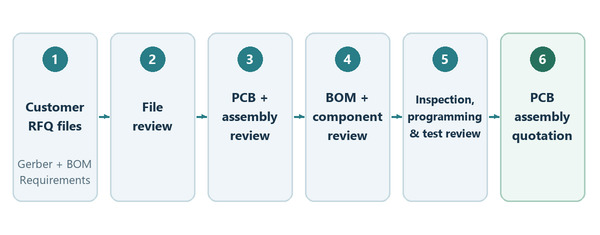
Step 1: Check File Completeness
The team first checks whether the files can be opened, whether the project revision is clear, and whether any missing information or obvious conflicts could affect the quote. Any issues are then clarified with the customer.
Step 2: Review PCB and Assembly Requirements
If the supplier is also responsible for PCB fabrication, the manufacturing data is reviewed for board construction, material, layer count, surface finish, and special processes.
Assembly complexity is assessed at the same time, including double-sided SMT, BGA or QFN packages, through-hole components, special connectors, and manual assembly requirements.
Step 3: Review the BOM
Purchasing checks whether MPNs are complete and whether parts can be sourced, including any MOQs, long lead times, shortages, or obsolete components.
For assemblies in which components make up a large share of the cost, this step has a direct impact on quotation accuracy.
Step 4: Confirm Inspection, Programming, and Test Scope
Any X-ray inspection, programming, in-circuit testing (ICT), functional testing, special inspection, or traceability requirements must also be included in the quoting scope.
Step 5: Prepare the Quotation
Once the main requirements are clear, the quote can account for PCB fabrication, component sourcing, SMT and through-hole assembly, programming, inspection, testing, fixtures, quantity, and lead time.
If some details are still open, the supplier may provide a preliminary quotation that clearly identifies the assumptions and items requiring later confirmation.
10. Quick Checklist Before Sending a PCB Assembly RFQ
Before your first inquiry, check whether the package includes or identifies:
- Gerber files or other PCB fabrication data;
- a BOM;
- complete manufacturer part numbers in the BOM;
- pick-and-place or centroid data, if available;
- an assembly drawing, if available;
- a consistent revision across the Gerber, BOM, and assembly data;
- the quantities to quote;
- the prototype, pilot, or production stage;
- PCB fabrication requirements;
- IPC or assembly acceptance requirements, if specified;
- inspection requirements, if any;
- programming requirements, if any;
- functional test requirements, if any;
- traceability requirements, if any;
- the target delivery date.
You do not need to delay the initial discussion because one or two noncritical documents are still being developed. The key is to make the confirmed information clear and flag anything that remains undecided.
Frequently Asked Questions
Can I Request a PCB Assembly Quote Without a Pick-and-Place File?
A preliminary assessment is often possible, depending on board complexity and the manufacturer’s quoting process.
SMT production will still need complete placement data. If you currently have only Gerber files and a BOM, submit those first and ask engineering to confirm what additional data will be needed.
Do I Need an Assembly Drawing If I Already Have Gerber Files?
The two serve different purposes. Gerber data primarily communicates PCB fabrication information. An assembly drawing is better suited to identifying component locations, orientation, polarity, DNP positions, and special assembly requirements.
For a complex project, an assembly drawing can reduce ambiguity during assembly preparation.
Can I Use ODB++ Instead of Gerber?
Some PCB and PCBA manufacturers accept ODB++ and other manufacturing data formats. Confirm the supported format with the supplier before submitting the package.
If you use Gerber, make sure the drill data, board outline, and relevant engineering notes are complete and consistent with the current project revision.
Does a Medical PCB Assembly Quote Have to Specify IPC Class 3?
No. The applicable IPC class should be selected according to the intended use, reliability requirements, risk assessment, and customer-approved project documents.
Some medical electronics projects may use Class 2 acceptance criteria, while particular high-reliability projects may specify Class 3. The project or purchasing documentation should identify the applicable class; it should not be assumed solely because the product is a medical device.
Do I Need a Complete Functional Test Procedure Before Requesting a Quote?
Not necessarily. If you want the assembly manufacturer to perform functional testing, identify the requirement at the RFQ stage.
If the procedure or fixture is still being developed, explain the expected test scope, whether a fixture already exists, and whether supplier support for test engineering is needed. This lets the supplier determine whether testing-related work needs to be included in the quotation.
What If My PCB Assembly Files Are Not All Ready Yet?
Submit the information you have. For a prototype or NPI project, the manufacturer can review the available Gerber files, BOM, and project requirements and identify:
- which missing details directly affect the quote;
- which documents must be completed before production;
- whether there are obvious file conflicts or information gaps.
This is often more efficient than waiting for every file to be “completely finished” before starting the first discussion.
What Is the Next Step Once Your Gerber Files and BOM Are Ready?
Once the PCB design is largely complete, organize the available manufacturing files, BOM, quantities, and project requirements into an RFQ package.
For medical PCB assembly, include programming, inspection, functional test, and traceability requirements alongside the board and component information.
If some documentation is still in progress, submit the available files for an initial review. This can reveal issues that affect quotation or production before an order is placed.