
The characteristics of SMT assembly can be understood more clearly by comparing it with traditional through-hole technology, or THT.
From an assembly perspective, the most fundamental difference between SMT and THT can be summarized as "mounting" versus "inserting." The two methods also differ in the types of components used, PCB structure, solder joint configuration, assembly density, and manufacturing process.
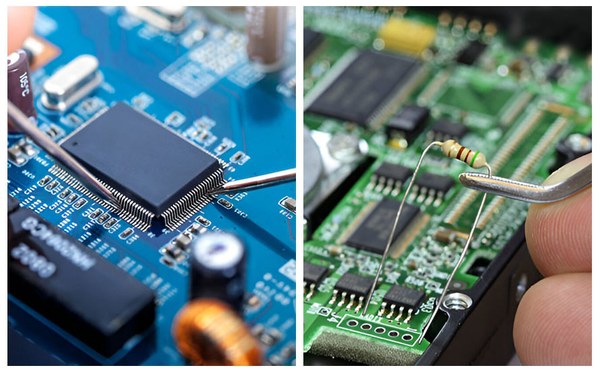
What Is the Difference Between SMT and THT Assembly?
THT: Components Are Inserted Through the PCB
THT uses components with leads.
During PCB design, holes are created for the component leads. The leads are inserted through these pre-drilled holes, temporarily secured, and then soldered on the opposite side of the board using processes such as wave soldering.
This creates reliable solder joints that provide both mechanical and electrical connections. In a typical THT assembly, the component body and the solder joints are located on opposite sides of the PCB.
Because THT components use leads and require mounting holes, board space becomes more limited as circuit density increases.
Longer leads also increase the electrical interconnection length. In high-speed or high-frequency circuits, these leads can introduce additional parasitic effects and unwanted signal interference.
SMT: Components Are Mounted Directly on the PCB Surface
Surface mount technology places chip components and other miniaturized components directly onto pads on the surface of a PCB.
The components are positioned according to the circuit design and are typically soldered using a reflow soldering process. In certain SMT applications, wave soldering may also be used.
SMT and THT therefore differ significantly in both component mounting and soldering methods.
In a traditional THT PCB, components are usually installed on one side of the board. Their leads pass through the PCB and are soldered on the opposite side.
In other words, the component body and solder joint are normally located on opposite sides of the PCB.
With SMT, components are mounted directly onto surface pads, so the component terminals and solder joints are located on the same side of the PCB.
SMT can also support double-sided assembly, allowing surface mount components to be placed on both sides of the board.
SMT Allows Higher PCB Assembly Density
In an SMT-dominant PCB design, far fewer through-holes are required for mounting components.
Instead, through-holes, blind vias, and other via structures are mainly used to create electrical connections between conductive layers of the PCB.
This frees up additional space for routing and component placement, allowing designers to achieve much higher assembly density.
The development of these two different assembly approaches – "inserting" and "mounting" – is closely related to the evolution of electronic component structures and lead configurations.
From this perspective, advances in PCB assembly technology have been strongly influenced by the development of electronic components themselves.
The functions of a PCB assembly or ceramic substrate assembly are created by the electronic components and their electrical interconnections. Changes in assembly methods have made it possible to increase circuit functionality and performance while reducing overall size and weight.
SMT and THT Component Mounting Methods
The two assembly methods can be understood simply as follows:
THT components: Component leads pass through holes in the PCB and are soldered on the opposite side.
SMT components: Components are mounted directly onto surface pads and soldered in place to create both electrical and mechanical connections.
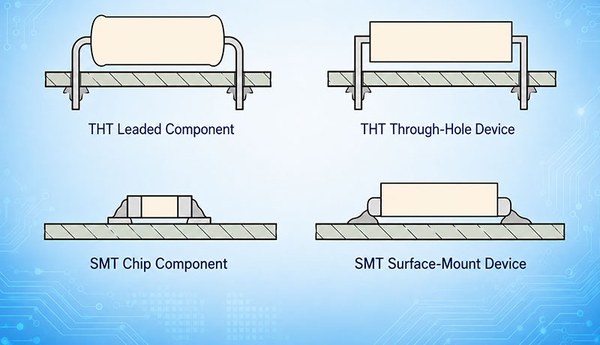
Compared with traditional through-hole assembly, SMT offers several important advantages.
Main Advantages of SMT Assembly
1. Supports Smaller and Lighter Electronic Products
SMT components generally occupy much less space than traditional through-hole components.
Traditional SMT technical references have noted that, compared with through-hole components, the required installation space can often be reduced by around 60% to 70%, and in some cases even more. Component weight can also be significantly reduced.
These figures mainly illustrate the large size difference between early SMT components and traditional THT components.
For modern electronic products, the actual size reduction depends on several factors, including component package size, PCB layer count, thermal requirements, and the mechanical design of the final product.
Smaller Components Use Less PCB Space
The combination of smaller components and surface mounting allows designers to place more components within a limited PCB area.
Unlike THT assembly, SMT does not require a large mounting hole and surrounding pad area for every component lead.
As a result, components can be placed much closer together.
Smaller components and higher assembly density are two of the main reasons SMT has played such an important role in making electronic products smaller and lighter.
2. Supports High-Speed Signal Transmission
SMT is characterized by compact construction, high assembly density, and short interconnections.
Double-sided SMT assembly can further increase component density.
Because SMT components generally use short leads or leadless packages, the distance between components can be reduced. Shorter signal paths can help reduce propagation delay and improve high-speed signal transmission.
Shorter Signal Paths
Shorter interconnections can be especially beneficial in high-speed electronic equipment.
As operating frequencies and signal edge rates increase, the length and geometry of the interconnections between components become increasingly important.
However, high-speed performance is not determined by SMT or THT alone.
Other PCB design factors, including layout, stackup, impedance control, via design, and return paths, also have a major impact on signal integrity.
It is therefore more accurate to say that the physical characteristics of SMT help support high-speed circuit design.
3. Better Suited to High-Frequency Circuits
SMT components commonly use leadless or short-lead package structures.
Compared with traditional through-hole components with longer leads, these structures can reduce parasitic inductance and capacitance introduced by the leads.
Reduced Effects from Long Component Leads
In high-frequency circuits, shorter component leads and shorter interconnection paths can help improve signal integrity and reduce some forms of electromagnetic interference.
For this reason, SMT is generally better suited to high-speed digital circuits, high-frequency circuits, and high-density PCB designs where short interconnections are important.
4. Well Suited to Automated Production
Another major advantage of SMT is its compatibility with highly automated manufacturing.
Surface mount components are generally standardized in terms of package dimensions, packaging formats, and feeding methods. This makes them well suited to automated production equipment.
A Highly Automated SMT Production Process
A typical SMT production line can automate processes such as:
- Solder paste printing
- Component placement
- Reflow soldering
- Automated inspection
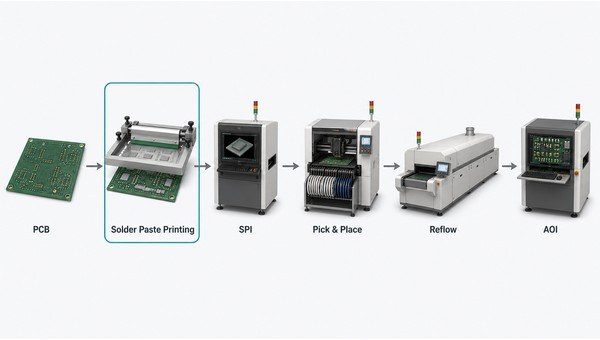
Compared with traditional assembly methods that rely heavily on manual component insertion, SMT can significantly reduce the amount of manual handling required.
Higher automation improves production efficiency while also reducing variation caused by manual operations.
Better Consistency in Volume Production
Stable placement and soldering processes also help maintain consistent quality across different PCBs and production batches.
Inspection technologies such as SPI, AOI, and X-ray can be used to monitor various process conditions and identify assembly defects.
The value of automation is therefore not limited to production speed. It also contributes to consistency and process stability in volume manufacturing.
5. Can Reduce Certain Material and Manufacturing Costs
As SMT components and automated manufacturing equipment have developed, many surface mount components have become highly standardized and are produced in very large quantities.
With the exception of certain components that are difficult to miniaturize or require specialized packaging, many SMT components benefit from lower packaging material usage and highly efficient mass production.
Cost Savings Are Not Only About Component Prices
It is important not to assume that an SMT component is always cheaper than an equivalent THT component.
Actual component pricing depends on many factors, including part number, package type, purchase volume, manufacturer, and market availability.
The more significant cost advantages of SMT often come from:
- Higher automation
- Faster production
- Fewer manual assembly operations
As production volume increases, the efficiency benefits of automated SMT assembly generally become more noticeable.
6. Simplifies the Assembly Process and Improves Production Efficiency
SMT can simplify several stages of the electronics assembly process.
With traditional through-hole components, leads may need to be formed, bent, inserted, trimmed, and soldered during PCB assembly.
Most surface mount components do not require these lead-preparation operations.
Instead, components can be placed directly onto the designated PCB pads using automated pick-and-place equipment, followed by reflow soldering.
Fewer Lead-Processing Steps
Reducing the number of assembly steps can shorten the overall production process and reduce the amount of manual handling required.
For volume PCB assembly, components can be placed and soldered continuously according to a programmed production process, resulting in higher overall manufacturing efficiency.
Traditional SMT technical references have suggested that, under certain manufacturing conditions, using SMT for circuits with the same functionality could reduce total production costs by around 30% to 50% compared with traditional through-hole assembly.
This figure is useful for understanding the potential cost benefits of SMT automation, but it should not be interpreted as a fixed saving for every modern PCBA project.
Actual production cost depends on factors such as production volume, component type, PCB complexity, testing requirements, and whether THT assembly is also required.
Has SMT Completely Replaced THT?
Although SMT offers clear advantages in miniaturization, high-density assembly, and automated production, THT has not been completely replaced.
In practical PCB assembly, certain large components, connectors, transformers, large electrolytic capacitors, and components exposed to significant mechanical stress may still be better suited to through-hole mounting.
Many PCBs Use Both SMT and THT
In real production, many PCB assemblies do not rely exclusively on SMT or THT.
Instead, both assembly methods are often used on the same board.
For example, small resistors, capacitors, and ICs may be assembled using SMT, while connectors, larger components, or components requiring stronger mechanical retention may use THT.
This type of mixed SMT and THT assembly is very common in modern electronics manufacturing.
Conclusion
The fundamental difference between SMT and THT lies in the way components are mounted.
THT uses an "insert-through-the-board" approach, where component leads pass through holes in the PCB before being soldered.
SMT uses a "mount-on-the-surface" approach, where components are placed and soldered directly onto PCB pads.
This change in assembly method reduces the number of mounting holes required, increases component density, and allows shorter electrical interconnections.
Compared with traditional THT assembly, SMT offers significant advantages in product miniaturization, assembly density, high-speed and high-frequency performance, automated manufacturing, and production efficiency. For these reasons, SMT has become one of the primary PCB assembly technologies used in modern electronics.
However, SMT and THT are not mutually exclusive.
In practical PCBA manufacturing, the most suitable approach is often to select or combine the two methods based on component type, electrical performance, mechanical strength, and product design requirements.