
For medical device OEMs, qualifying a PCB or PCBA supplier involves more than checking equipment lists or assembly capabilities. The supplier also needs a quality system that can control product revisions, components, manufacturing processes, inspection records, traceability, and engineering changes throughout the life of the project.
This is where ISO 13485 becomes relevant.
ISO 13485 is a quality management system standard developed for organizations involved in medical devices and related services. In PCB manufacturing, it provides a framework for controlling how medical PCB and PCBA projects are documented, produced, inspected, and maintained.
A PCB itself is not “ISO 13485 certified.” Instead, the PCB or PCBA may be manufactured by an organization whose quality management system is ISO 13485 certified and whose certification scope covers the relevant manufacturing activities.
For medical OEMs and sourcing teams, that distinction is important. A certificate can be a useful starting point, but supplier qualification should also consider the certificate scope, the manufacturing site, the supplier’s actual production controls, and whether the factory has the technical capability required by the project.
This guide explains how ISO 13485 applies to PCB manufacturing and assembly, what it does and does not cover, and what to verify when evaluating a medical PCB supplier.
How Does ISO 13485 Apply to PCB Manufacturing?
Does ISO 13485 Certify the PCB Itself?
No. ISO 13485 certification applies to an organization’s quality management system and the activities included within its certified scope.
For a medical PCB or PCBA project, the practical question is whether the manufacturing activities involved in your project are covered by that scope.
For example, when reviewing a supplier, check:
- the legal entity named on the certificate
- the manufacturing site covered
- the certificate validity
- the certification scope
- whether PCB fabrication, assembly, or related activities are included
This provides much more useful information than simply seeing an ISO 13485 logo on a supplier’s website.
Is ISO 13485:2016 Still Current in 2026?
Yes.
ISO 13485:2016 remains the current edition. It was reviewed and confirmed again in 2025.
For supplier qualification in 2026, ISO 13485:2016 remains the relevant version for quality management system certification.
Does Every Medical PCB Supplier Need ISO 13485 Certification?
Not necessarily.
Whether certification is required depends on the supplier’s role, the target market, the medical device manufacturer’s supplier controls, contractual requirements, and the risk associated with the outsourced activity.
For PCB and PCBA suppliers working directly within a controlled medical device supply chain, however, ISO 13485 certification can provide a useful foundation for supplier qualification.
It gives OEMs a framework for evaluating how a manufacturer controls production documents, suppliers, components, manufacturing processes, nonconforming product, changes, and quality records.
The certificate itself does not show how well those controls work in daily production. That requires a closer look at the factory’s actual processes.
Where ISO 13485 Shows Up in PCB Manufacturing and Assembly
The impact of ISO 13485 becomes easier to understand when it is translated into normal PCB manufacturing activities.
Medical PCBA quality is not defined by one set of universal process parameters. It depends on controlled product data, approved materials, stable manufacturing processes, appropriate inspection and testing, documented changes, and traceable production records.
Document and Revision Control
A PCB assembly build package usually contains more than Gerber files.
Depending on the project, it may include:
- BOM
- Pick-and-place data
- Assembly drawings
- Programming files
- Test specifications
- Stencil requirements
- Special process instructions
- Customer acceptance requirements
These files must remain aligned to the same approved product revision.
For example, a factory may receive a Rev C Gerber package while the production system still contains a Rev B BOM. Neither file is necessarily incorrect on its own, but using them together can produce the wrong product configuration.
Similar problems occur when firmware changes but the test program does not, or when an ECO is approved while work-in-process is still being built to the previous revision.
Good document control answers a simple production question:
Which approved product configuration is the factory building right now?
Supplier, Component, and Material Control
Component control also goes beyond simply finding available stock.
A reliable component verification process typically connects the BOM to the manufacturer part number, datasheet, package, electrical characteristics, polarity, lot information, and approved substitution status.
Alternate components are a common example.
A part with similar headline specifications may still affect footprint compatibility, electrical behavior, thermal performance, firmware, or test limits. For long-life medical products, component lifecycle status and change approval can become just as important as short-term availability.
An alternate part should therefore be treated as an engineering change, not simply as a purchasing decision.
Production and Process Control
Once the product enters production, the assembly process has to be built around the actual board.
Solder paste, stencil design, placement settings, and reflow profiles depend on factors such as component packages, PCB construction, thermal mass, solder paste chemistry, equipment, and product requirements.
There is no single reflow temperature, process capability target, oxygen limit, or burn-in duration that applies to every medical PCBA.
The manufacturing plan should define the process for the specific product, control the important parameters, and establish what happens when the process moves outside the approved window.
Inspection, Testing, and Manufacturing Records
PCB inspection should be selected according to the failures a project needs to detect.
| Inspection or Test | Typical Role |
|---|---|
| SPI | Checks solder paste height, area, volume, and positional issues |
| AOI | Finds missing, shifted, reversed, or visibly defective components and solder joints |
| X-Ray | Examines hidden solder joints and internal structures such as BGA connections |
| ICT / Flying Probe | Checks accessible electrical networks, opens, shorts, and selected component parameters |
| FCT | Verifies board function under defined inputs, loads, interfaces, and firmware conditions |
These methods complement one another.
AOI can identify many visible assembly defects, but it cannot directly inspect solder joints underneath a BGA. X-Ray can reveal hidden structures, but it does not replace functional testing. ICT coverage depends heavily on test access and DFT decisions made during design.
For that reason, ISO 13485 does not prescribe one universal combination of AOI, X-Ray, ICT, and FCT for every medical PCB assembly.
A better approach is to identify the relevant failure modes first, then define the inspection method, acceptance criteria, and reaction plan for each one.
Nonconformance, Rework, and Change Control
Manufacturing defects and process deviations can happen even in a well-controlled factory. The quality system determines what happens next.
Nonconforming assemblies should be identified, segregated, reviewed, and dispositioned according to controlled procedures. If rework is permitted, the affected product should be reinspected or retested before release.
Changes also need controlled implementation.
A component substitution, PCB revision, stencil change, firmware update, test-program revision, or major process change may affect more than one production document. The BOM, work instructions, programs, inspection requirements, and validation activities may all need to be updated together.
This is especially important for long-life medical products that remain in production for years.
Traceability
Traceability becomes valuable when a quality issue has to be investigated.
Depending on project requirements, useful records may connect a finished PCBA to:
- Production lot
- PCB manufacturing lot
- Critical component lots
- PCBA serial number
- Firmware revision
- Test-program revision
- Inspection and test status
- Rework or deviation records
SugaMed can establish production lot, PCB lot, critical component lot, PCBA serial number, firmware version, test procedure revision, and inspection or test status records according to project requirements.
This type of traceability can help an OEM narrow the affected population during an investigation rather than treating every unit produced over a long period as part of the same suspect group.
The required traceability depth should still be defined for each project. ISO 13485 does not mean that every component on every medical PCB must always be tracked at the same level.
What ISO 13485 Does Not Tell You About a PCB
ISO 13485 is important, but it does not replace the engineering requirements for the board itself.
It Does Not Define PCB Electrical or Fabrication Specifications
ISO 13485 does not specify PCB layer count, stackup, copper weight, controlled impedance, via structure, HDI architecture, laminate selection, or fine-pitch package capability.
Those requirements come from the product design, PCB fabrication specification, and approved project documentation.
A manufacturer can have a certified quality management system and still lack the technical capability to build a specific board.
Quality-system qualification and manufacturing capability should therefore be evaluated separately.
ISO 13485 Does Not Automatically Mean IPC Class 3
ISO 13485 and IPC standards serve different purposes.
ISO 13485 addresses the medical-device quality management system.
IPC-A-610 addresses the acceptability of electronic assemblies, while J-STD-001 addresses requirements for soldered electrical and electronic assemblies.
A medical application does not automatically make every PCBA an IPC Class 3 build.
The applicable class should be defined according to the product’s use, reliability requirements, customer specification, risk, and contractual requirements.
At SugaMed, the current default assembly acceptance level is IPC-A-610 Class 2 when project-approved documentation does not specify otherwise. IPC Class 3 can be supported when required by the product, customer, or project.
Cleanrooms, X-Ray, ICT, and FCT Are Project Decisions
ISO 13485 does not automatically require a specific cleanroom class or a fixed set of inspection methods.
Cleanroom requirements depend on the product and manufacturing process.
X-Ray coverage depends on package structure and project risk.
ICT depends on electrical access and DFT.
FCT must be designed around the product’s functions, interfaces, firmware, and approved test requirements.
For example, SugaMed has ISO Class 7 cleanroom capability available for applicable projects and performs 100% X-Ray inspection on BGA solder joints under its current controlled manufacturing capability.
These are specific manufacturing capabilities. They are not universal ISO 13485 requirements.
ISO 13485 Does Not Approve the Finished Medical Device
Working with an ISO 13485-certified PCB assembly supplier does not make the finished medical device FDA-cleared, CE-marked, IEC 60601-compliant, or otherwise approved for market access.
The PCB/PCBA manufacturer is responsible for the activities within its contracted manufacturing scope.
The finished device manufacturer remains responsible for the regulatory obligations that apply to the final medical device.
ISO 13485 vs. ISO 9001 vs. IPC Standards
These standards may all appear on a PCB manufacturer’s website, but they address different parts of quality and manufacturing.
| Standard or Framework | Main Role | Relevance to PCB/PCBA |
|---|---|---|
| ISO 13485 | Medical-device quality management system | Controls areas such as documents, suppliers, manufacturing, records, and changes |
| ISO 9001 | General quality management system | Provides a broad organizational quality framework |
| IPC-A-610 | Electronic assembly acceptability | Used to evaluate assembly workmanship and acceptance |
| J-STD-001 | Soldered assembly requirements | Covers requirements related to soldering processes, materials, and assemblies |
It is not useful to ask whether ISO 13485 is “higher” than IPC-A-610.
They answer different questions.
A supplier may operate under a strong ISO 13485 quality system while each individual project still needs its own PCB specification, assembly acceptance criteria, and test plan.
What Changed With FDA QMSR in 2026?
For medical device companies selling into the United States, the regulatory context changed in 2026.
The FDA’s Quality Management System Regulation, or QMSR, became effective on February 2, 2026. The revised 21 CFR Part 820 incorporates ISO 13485:2016 by reference.
FDA also transitioned to a new medical-device manufacturing inspection approach when QMSR became effective.
For medical OEMs, this makes ISO 13485 even more relevant to the quality systems used throughout the medical-device supply chain.
However, using an ISO 13485-certified PCB supplier does not transfer the finished-device manufacturer’s regulatory responsibilities to the PCB assembly company.
A useful way to think about the relationship is:
Supplier ISO 13485 certification supports a controlled medical-device supply chain, but it does not replace finished-device regulatory compliance.
How Should You Verify an ISO 13485 PCB Assembly Supplier?
A certificate PDF alone is not enough to qualify a supplier.
A practical review should cover both the quality system and the factory’s technical ability to manufacture the board.
Verify the Certificate
Check the legal entity, manufacturing site, validity period, certification body, and certificate scope.
The scope is especially important.
If you are outsourcing PCB fabrication or assembly, the certificate should cover activities that are relevant to the work being performed.
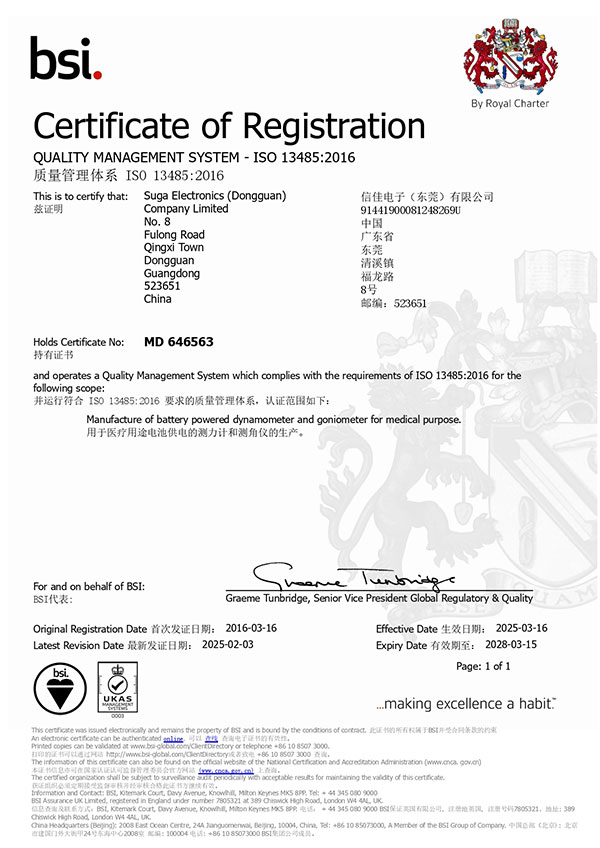
For example, Suga Electronics (Dongguan) Company Limited, the manufacturing entity supporting SugaMed, holds ISO 13485:2016 certificate MD 646563. Its certification scope covers design support, fabrication, and assembly of printed circuit boards for use in medical devices.
That information is more useful than simply seeing an ISO 13485 logo on a website.
Check How the QMS Works on the Factory Floor
Supplier audits become much more informative when the questions are tied to normal production.
For example:
- What happens if the BOM and Gerber revisions do not match?
- Who can approve an alternate component?
- How is work-in-process handled after an ECO?
- How are rework and reinspection recorded?
- How does the line prevent an obsolete test program from being used?
These questions reveal how document control, component control, nonconformance handling, and change management work in practice.
Verify Technical Capability Separately
ISO 13485 certification does not prove that a manufacturer can build every type of medical PCB.
Projects involving HDI, rigid-flex construction, 01005 components, fine-pitch BGA/QFN packages, or complex functional testing require separate technical evaluation.
SugaMed’s current manufacturing capability includes 01005 placement, 0.35 mm pitch BGA and QFN, HDI and rigid-flex PCB/PCBA, as well as ICT, FCT, and ATE capabilities.
These facts answer one question:
Can the factory manufacture and test this design?
ISO 13485 answers another:
How are those activities controlled within the quality system?
Medical PCB supplier qualification usually requires both answers.
Define Project Requirements Before Production
Even after a supplier is qualified, the project itself still needs a controlled manufacturing baseline.
Before production, the OEM and manufacturer should agree on items such as:
- Approved production files and revisions
- BOM and permitted alternates
- IPC acceptance class
- Inspection scope
- X-Ray requirements
- ICT or FCT requirements
- Firmware revision
- Traceability level
- Change-notification rules
- Rework and acceptance criteria
A strong quality system cannot compensate for a project specification that was never clearly defined.
ISO 13485 PCB Assembly Supplier Checklist
The following checklist can be used as a first-pass supplier qualification tool.
| What to Check | What to Verify | Why It Matters |
|---|---|---|
| ISO 13485 certificate | Legal entity, site, validity, and scope | Confirms that the relevant facility and activities are covered |
| Document control | Controlled Gerber, BOM, assembly, and test files | Reduces mixed-revision risk |
| Component control | MPNs, approved alternates, and supplier controls | Prevents unauthorized substitutions |
| Traceability | Lot, serial, component, firmware, and test records | Supports investigations and containment |
| Inspection and testing | Project-specific SPI, AOI, X-Ray, ICT, or FCT plan | Matches test methods to actual failure risks |
| Nonconformance and rework | Disposition, rework, and reinspection records | Confirms closed-loop handling of defects |
| Change control | ECO/ECN and WIP control process | Prevents uncontrolled production changes |
| Technical capability | PCB technology, package, assembly, and test capability | Confirms the supplier can actually build the design |
An ISO 13485 certificate is valuable, but it answers only part of the supplier qualification question.
A more complete review looks at whether the certificate scope matches the actual manufacturing site, how product revisions and components are controlled, how defects and changes are handled, what traceability records are available, and whether the factory has the technical capability required by the design.
For medical PCB assembly projects moving from prototype through NPI and into production, defining these requirements early can reduce later problems with revision control, component substitutions, testing, and quality records.
SugaMed operates within an ISO 13485:2016-certified manufacturing system and supports PCB fabrication, component sourcing, PCB assembly, inspection, and testing for medical electronics projects. If you are evaluating a new medical PCBA project, you can provide your Gerber files, BOM, assembly drawings, and test or traceability requirements for an engineering review.