
A halogen-free PCB is a printed circuit board manufactured using laminates that contain no bromine or chlorine above defined threshold levels. The distinction matters for environmental compliance, end-of-life disposal, and supply chain requirements from major OEM customers.
Table of Contents
What “Halogen-Free” Actually Means in PCB
The standard that defines halogen-free for PCB laminates is IEC 61249-2-21. Under this standard, a laminate qualifies as halogen-free when:
- Chlorine (Cl) ≤ 900 ppm
- Bromine (Br) ≤ 900 ppm
- Combined Cl + Br ≤ 1,500 ppm
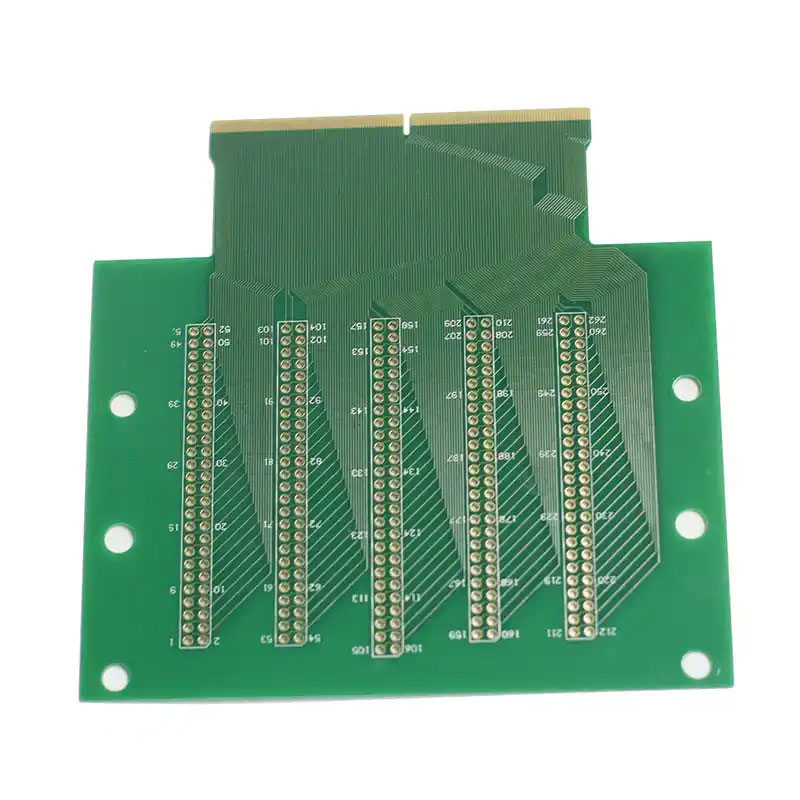
Conventional FR4 uses brominated epoxy resin — specifically tetrabromobisphenol A (TBBPA) — as its primary flame retardant. When these laminates burn, they release hydrogen chloride (HCl) and hydrogen bromide (HBr), both corrosive and toxic. Halogen-free laminates replace brominated systems with phosphorus- or nitrogen-based flame retardants. These alternatives do not generate the same byproducts.
Two misconceptions appear consistently in sourcing conversations.
Halogen-free is not the same as RoHS. RoHS restricts specific brominated flame retardants — PBB and PBDE — but does not cover all halogens. A board can be RoHS-compliant while still containing chlorine above halogen-free thresholds. These are independent requirements, and both may apply to the same product.
Halogen-free is not the same as lead-free. Lead-free refers to solder alloy composition. Halogen-free refers to laminate chemistry. They address different parts of the board. A project may require one, both, or neither depending on its target market.
Halogen-Free PCB Material Options : FR4, Aluminum, and CEM3
Halogen-Free FR4
Halogen-free FR4 is the most widely used option and the default choice for most applications requiring halogen-free compliance. The resin system uses phosphorus- or nitrogen-based flame retardants instead of brominated compounds. The glass fabric and copper foil remain the same as standard FR4.
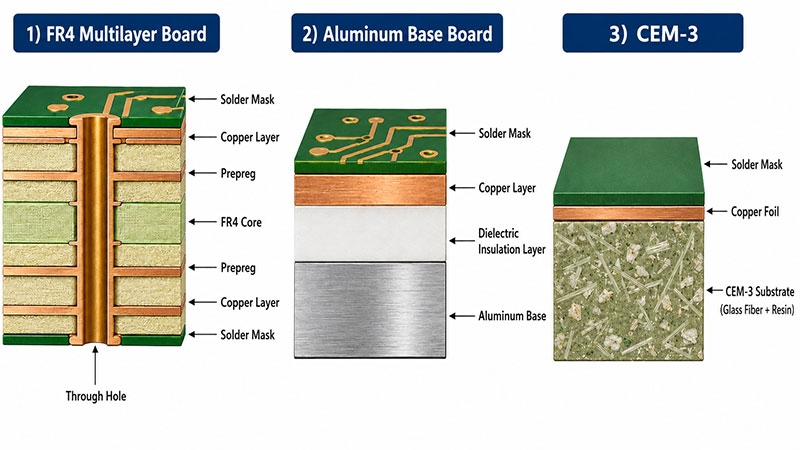
Practical specs:
- Tg: 130–180°C depending on grade; Tg 150°C is common for lead-free reflow processes
- Dk: 4.3–4.5 at 1 GHz, comparable to standard FR4
- Processing: compatible with standard drilling, etching, and lamination — no process change required
Halogen-free FR4 supports multilayer construction, HDI, and standard SMT assembly. For most engineers transitioning from standard FR4, the material change is transparent at the fabrication level.
Halogen-Free Aluminum PCB
Aluminum PCBs are used where heat dissipation is the primary design constraint. LED lighting assemblies, motor driver boards, and power supply modules are typical applications.
The aluminum substrate itself does not contain halogens. However, the dielectric insulation layer between the aluminum base and the copper circuit layer may. To produce a halogen-free aluminum PCB, both the laminate and the dielectric layer must meet IEC 61249-2-21 thresholds.
Key specs:
- Thermal conductivity: 1–3 W/m·K depending on dielectric formulation
- Dielectric thickness: 75–150 µm for standard LED applications
When specifying halogen-free aluminum PCB, request a datasheet that covers the dielectric layer specifically. A supplier who provides only the aluminum base specification has not answered the question.
Halogen-Free CEM3
CEM3 (Composite Epoxy Material Grade 3) is a glass fiber and epoxy composite. It sits between standard FR4 and paper-based laminates in cost and performance. It is used for single- and double-sided boards where multilayer construction is not required.
Three constraints apply:
- CEM3 cannot be used for multilayer boards. It does not support reliable interlayer bonding under the mechanical stress of multiple lamination cycles.
- Not all CEM3 is halogen-free. The halogen-free variant must be explicitly specified — standard CEM3 typically uses brominated resin.
- Supplier availability is narrower than FR4. If halogen-free CEM3 is part of a volume production plan, confirm material availability and lead time before finalizing the design.
For projects where cost pressure is significant and the design is single- or double-sided, halogen-free CEM3 is a viable choice. For anything beyond two copper layers, use halogen-free FR4.
Does your project require halogen-free PCBs?
Whether a project requires halogen-free PCB is determined by the target market, customer requirements, and applicable regulations — not by the circuit design itself.
Requirements are mandatory in these situations:
- Export to the EU: The EU Ecodesign Regulation and some product category regulations reference halogen-free materials for specific applications.
- OEM supply chains: Major consumer electronics brands — including Apple, Dell, and HP — require halogen-free materials from their suppliers as part of green procurement programs. If you are entering one of these supply chains, the requirement is non-negotiable.
- Medical devices: ISO 13485-certified manufacturers and medical OEMs commonly require halogen-free laminates for devices used in or near patients.
- Automotive electronics: AEC-Q standards do not directly mandate halogen-free, but many Tier 1 automotive suppliers include it in their PCB specifications.
Common but not universal:
Consumer electronics, industrial control, and LED lighting products frequently require halogen-free materials. But the specific requirement depends on the customer’s product specification, not the product category alone. Always confirm against the actual customer requirement document.
When standard FR4 is acceptable:
Low-cost consumer products with no export requirement, short-lifecycle products with no end-of-life disposal obligations, and domestically distributed products outside OEM green procurement programs can typically use standard FR4. In these cases, the halogen-free premium adds no functional benefit.
The Real Cost of Switching — What to Expect
| Dimension | Halogen-Free FR4 | Standard FR4 |
|---|---|---|
| Material cost | +10–30% above standard | Baseline |
| Lead-free reflow compatibility | Strong with Tg ≥ 150°C | Confirm Tg before specifying |
| Moisture absorption | Slightly higher | Lower |
| Availability | Mainstream grades widely stocked | More universally available |
| Documentation required | Datasheet + compliance statement | Standard datasheet |
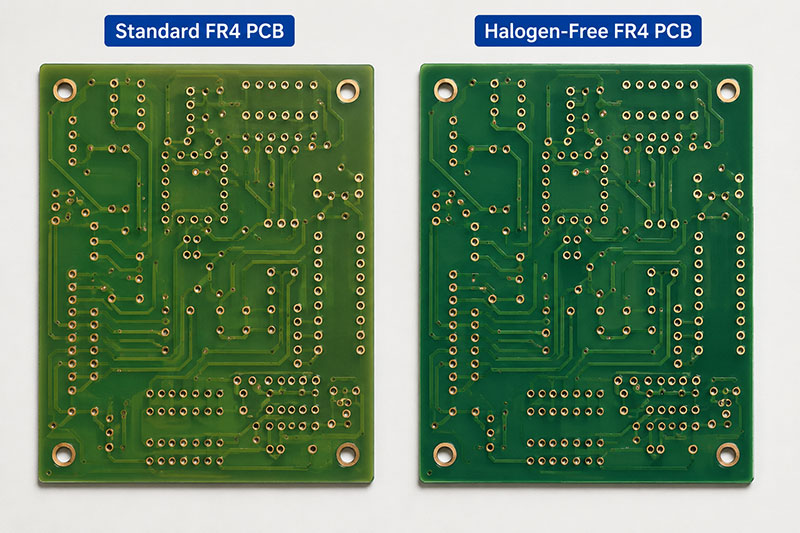
The moisture absorption difference deserves a specific note. Halogen-free resins are slightly more hygroscopic than brominated equivalents. This can increase the risk of CAF (Conductive Anodic Filament) — a failure mode where conductive deposits form between conductors in high-humidity environments. For most commercial applications, this does not require a design change. For boards operating continuously at high humidity, it is worth reviewing with your laminate supplier.
Decision logic: No compliance requirement → standard FR4 is more cost-effective. Halogen-free required → mainstream Tg 150°C grades carry a predictable premium, typically under 20% for standard stack-ups.
How to Lock In the Requirement Before Production
Specifying halogen-free requires explicit language in fabrication notes. “Green” or “environmentally friendly” is not a specification — it does not bind the supplier to a testable standard.
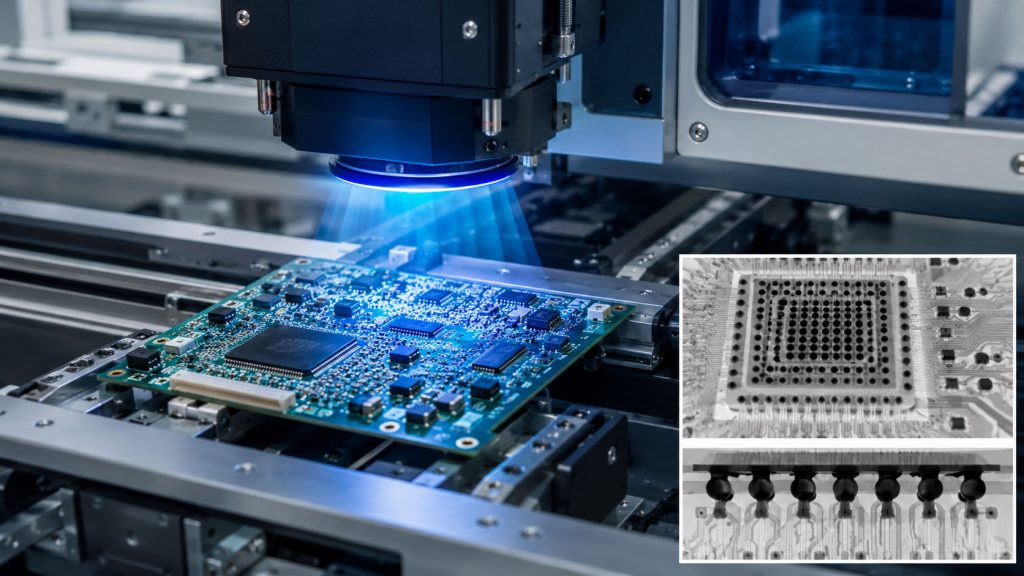
Include in your fab notes:
- Laminate standard: IEC 61249-2-21 compliant
- Material type: halogen-free FR4 / halogen-free aluminum / halogen-free CEM3
- Tg requirement: e.g., Tg ≥ 150°C for lead-free reflow
- Documentation: material datasheet and compliance statement required before production release
Example fab note:
“Please use halogen-free FR4, Tg 150°C or above, IEC 61249-2-21 compliant. Material datasheet and compliance statement required before production.”
Confirm material availability at the prototype stage, not at volume production. CEM3 in particular has limited supplier coverage — switching materials after prototype approval may require re-qualification. For aluminum PCBs, request the datasheet for the dielectric layer specifically, not just the aluminum base.
Frequently Asked Questions
Is standard FR4 halogen-free?
No. Standard FR4 uses brominated epoxy resin as its flame retardant. Halogen-free FR4 must be explicitly specified and confirmed with a material datasheet.
Is halogen-free the same as RoHS compliant?
No. RoHS restricts specific brominated compounds (PBB and PBDE). Halogen-free covers all chlorine and bromine content above IEC 61249-2-21 thresholds. A board can be RoHS-compliant without being halogen-free.
Can an aluminum PCB be halogen-free?
Yes, but confirmation requires a datasheet covering the dielectric insulation layer — not just the aluminum substrate. The substrate does not contain halogens; the dielectric layer may.
Does halogen-free PCB cost significantly more?
For mainstream grades, the premium is typically 10–30% over standard FR4, depending on Tg level and order volume. Specialty halogen-free materials at higher Tg or with tighter electrical specs carry higher premiums.
If your project requires halogen-free PCB materials, confirm the requirement before fabrication. Send us your Gerber files, stack-up, and material specification — our engineering team will confirm a suitable halogen-free solution before production starts.